
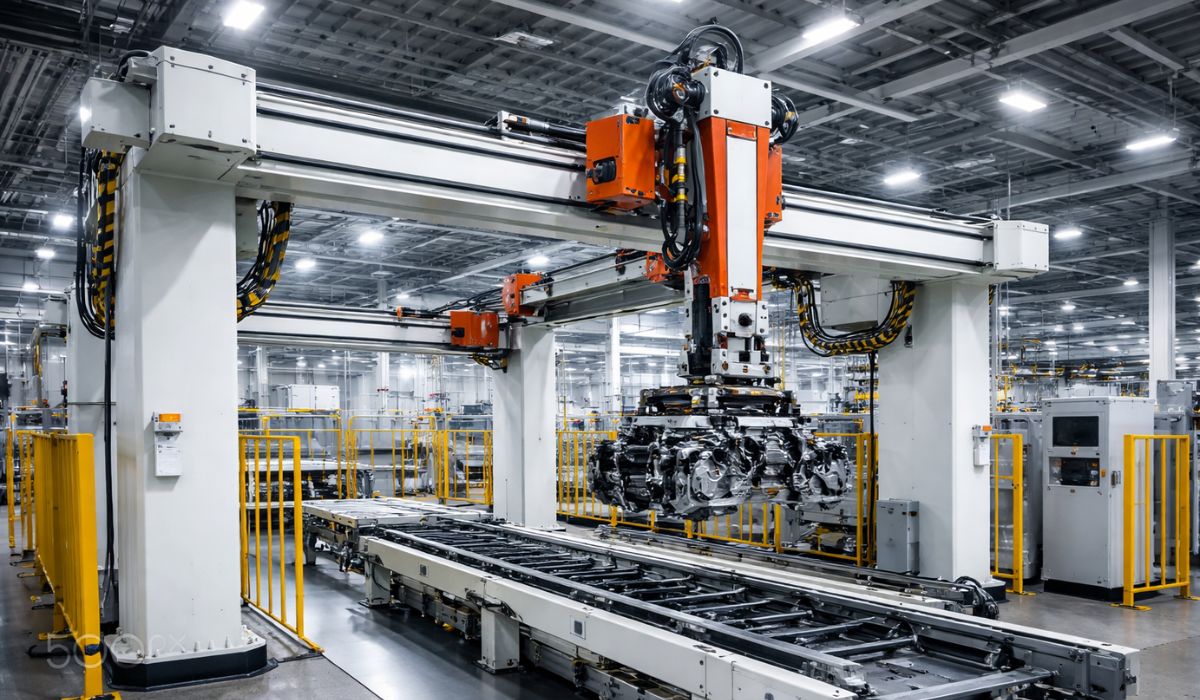
Indian manufacturing is shifting toward high-precision, high-throughput automation. For applications involving heavy payloads, long travel distances, and structured linear motion, a Gantry Automation System provides superior rigidity, repeatability, and scalability compared to conventional robotic arms.
Parc Robotics engineers and integrates industrial gantry automation systems tailored for automotive, heavy engineering, fabrication, and precision manufacturing facilities across India.
These systems are designed for durability, cycle-time optimization, and seamless PLC-based plant integration.
What is a Gantry Automation System?
A Gantry Automation System (also referred to as a gantry robot system or Cartesian gantry automation system) is a multi-axis linear motion platform that operates along X, Y, and Z axes on a rigid structural framework.
Unlike articulated robots that use rotational joints, gantry systems rely on linear movement. This results in:
-
Higher structural stiffness
-
Better positional accuracy over long spans
-
Increased load-handling capability
-
Reduced vibration under heavy payloads
For rectangular work envelopes and structured transfer applications, gantry automation offers a more efficient engineering solution.
Engineering Architecture of an Industrial Gantry System
A properly designed gantry automation system includes:
Structural Framework
-
Heavy-duty fabricated steel or reinforced aluminum frame
-
Finite element analysis (FEA)-validated design
-
Load-distribution optimized beams
Motion System
-
Precision linear guideways
-
Rack and pinion or ball screw drive
-
Servo motor-driven axis control
-
Synchronized multi-axis motion programming
Control & Integration
-
PLC-based control system (Siemens / Allen Bradley / Mitsubishi compatible)
-
HMI interface
-
Safety interlocks and light curtain integration
-
SCADA / MES integration capability
End-of-Arm Tooling
-
Custom grippers
-
Vacuum systems
-
Magnetic clamps
-
Welding support fixtures
Every axis is sized based on payload, acceleration requirements, and duty cycle analysis.
Technical Capabilities
Industrial gantry automation systems in Indian manufacturing environments are typically engineered for:
-
Payload capacity: 20 kg to 500+ kg (custom-engineered higher loads possible)
-
Positioning accuracy: ±0.05 mm to ±0.2 mm
-
Travel range: Up to several meters depending on layout
-
Repeatability: High-precision servo synchronization
-
Duty cycle: Continuous industrial operation
-
Modular scalability
System performance is determined through cycle-time simulation and structural validation before deployment.
Applications in Indian Manufacturing
Automotive Industry
-
Engine block handling
-
BIW component transfer
-
Machining station loading
-
Transfer automation between CNC systems
Heavy Engineering
-
Fabricated structure handling
-
Large component positioning
-
Assembly line part transfer
Machine Tending
-
Multi-machine automation cells
-
High-speed loading/unloading operations
Inspection & Quality Automation
-
Vision-guided part positioning
-
Dimensional scanning automation
In many Indian production setups, gantry automation systems are preferred for repetitive, structured motion tasks where reach and rigidity matter more than articulation flexibility.
Gantry Automation vs Articulated Robot: Engineering Comparison
Choosing incorrectly increases cost and complexity.
Choose Gantry When:
-
Large rectangular work area
-
Heavy payload handling
-
Linear repetitive movement
-
Lower maintenance requirement
-
High rigidity needed
Choose Articulated Robot When:
-
Complex 3D movement paths
-
Welding arcs with angular variability
-
Compact space constraints
For material transfer and structured motion tasks, gantry systems often deliver better ROI in Indian industrial environments.
Engineering Process Followed
An industry-grade gantry automation system is never “assembled.” It is engineered.
Typical development stages include:
-
Application feasibility study
-
Payload and inertia calculation
-
Servo motor sizing
-
Structural load validation
-
Motion simulation
-
Electrical panel design
-
Safety compliance integration
-
On-site commissioning
This structured engineering approach ensures reliability under Indian industrial operating conditions.
Case-Based Application Example
Application: Automotive component transfer
Challenge: Manual transfer between two CNC machines causing cycle delay
Solution: 3-axis gantry automation system integrated with PLC
Outcome:
-
Reduced cycle time
-
Improved repeatability
-
Reduced manual dependency
-
Increased production consistency
Real-world deployments demonstrate measurable improvements in throughput and precision.
Why Gantry Automation is Critical for Indian Manufacturing Growth

Indian factories face:
-
High production targets
-
Skilled labor variability
-
Quality compliance pressure
-
Cost optimization requirements
A gantry automation system directly addresses these factors by ensuring:
-
Consistent output
-
Reduced human intervention
-
Improved safety
-
Long-term operational stability
Frequently Asked Questions
What industries use gantry automation systems in India?
Primarily automotive, heavy engineering, fabrication, and precision manufacturing industries.
Can gantry systems handle heavy loads?
Yes. Industrial gantry automation systems are engineered specifically for medium to heavy payload applications.
Is gantry automation better than a robotic arm?
It depends on the application. For structured, linear, heavy-duty tasks, gantry systems are often more efficient.
Can gantry systems integrate with existing production lines?
Yes. They are designed for PLC integration and plant-level automation compatibility.