
Quick Takeaways (for the busy production head):
-
Industrial robotics automation is a tool, not a magic fix – process engineering is 80% of success.
-
Indian manufacturers face unique challenges: labour attrition, OEM quality pressure, and global competition.
-
Real ROI timeline: 1.5 to 3 years – anyone promising faster without studying your process is guessing.
-
Parc Robotics has delivered industrial automation systems since 2016 for Tata, Mahindra, Hero, Honda, and Toyota.
Introduction
Most manufacturers do not need industrial robotics automation. They need higher output without hiring more people. They need consistent quality without rework. They need lower dependency on manual labour. And they need faster cycle times.
Industrial robotics automation is just a tool. The real question is whether it can solve your specific production bottleneck profitably.
If you are running operations in automotive, aerospace, or medical device manufacturing, you already face tight margins, brutal quality standards, and contracts that can be lost due to delays. The pressure from OEMs like Tata, Mahindra, Hero, Honda, and Toyota is relentless. Every rejection counts. Every hour of downtime costs money.
This guide is not academic theory. It is built from real-world execution of industrial automation systems in Indian manufacturing environments, where constraints like power fluctuations, unplanned labour absenteeism, and tight capital budgets are daily realities. If you are a production head, factory owner, or operations decision-maker, this guide will help you decide whether industrial robotics automation makes sense for your factory right now.
What is Industrial Robotics Automation (A Practical View)
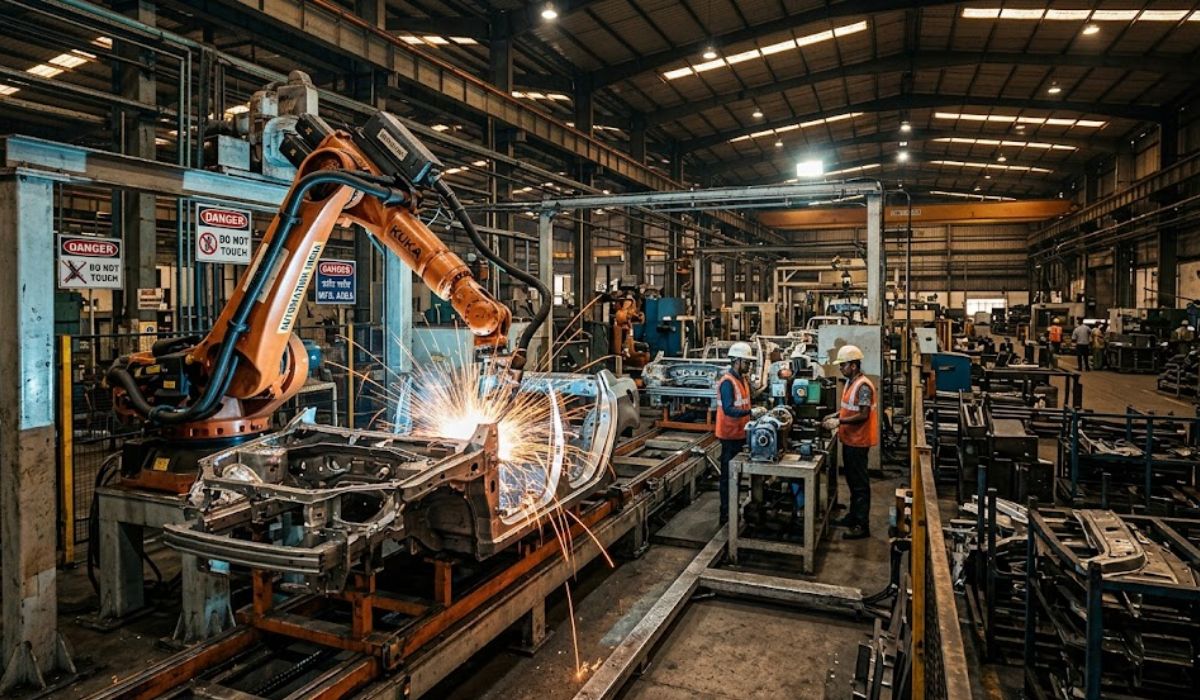
Forget the textbook definitions you find online. In a real factory, industrial robotics automation means designing a complete system where robotic arms, custom tooling, fixtures, conveyors, programmable logic controllers (PLCs), and software work together to execute a manufacturing process faster, safer, and more consistently than humans can.
A typical industrial automation system includes:
-
Robotic arms (articulated, Cartesian, SCARA, or collaborative)
-
Custom-built Special Purpose Machines (SPMs)
-
Precision fixtures and end-of-arm tooling
-
PLC-based control systems
-
Vision inspection or sensor feedback loops
-
Human-machine interface (HMI) for monitoring
A critical truth that most equipment vendors will not tell you: a robot alone is useless. A standalone robotic arm is just a dumb machine. It has no idea what to do, where to move, or how hard to grip. The entire value comes from the system design around it.
Most failures in robotic automation in manufacturing happen because companies buy a robot first and then try to figure out how to use it. That is backwards. The correct sequence is: study the process, identify the bottleneck, design the system, then select the right robot. Process engineering is 80% of success. The robot is only 20%.
Why Industrial Robotics Automation is Critical for Indian Manufacturing Right Now
Let us be direct. If your factory is still heavily dependent on manual processes, you are already losing competitiveness. Here is why.
Labour is not reliable at scale
Indian manufacturers face high attrition rates, especially in high-volume production. Skilled welders, assembly technicians, and machine operators leave for a small salary increase. Training new workers takes months. Quality fluctuates with every shift change. A robotic system does not leave after six months. It does not argue with the supervisor. It does not come to work hungover.
Quality expectations from OEMs are rising
Companies like Tata, Mahindra, Toyota, and Honda have zero tolerance for variation. They demand micron-level precision, repeatability, and full traceability. Manual processes simply cannot deliver that consistently across three shifts. Every rejected part is not just a cost. It is a risk to your vendor rating and future contracts.
Production pressure is increasing
Indian OEMs are scaling faster than ever. They expect suppliers to keep up. If you cannot deliver higher volumes with shorter lead times, they will find someone who can. Manual scaling means hiring, training, managing, and dealing with chaos. Automated scaling means adding a second shift of robots that work exactly the same as the first shift.
Global competition is real
You are no longer competing only with the factory next door. You are competing with suppliers in China, Vietnam, Germany, and Southeast Asia. Those competitors have already automated core processes. Without factory automation solutions India cannot win the cost-plus-quality equation. It is not about being better. It is about staying in the race.
This is not a technology trend. Industrial robotics automation is a competitive necessity for Indian manufacturing.
Core Applications of Industrial Robotics Automation
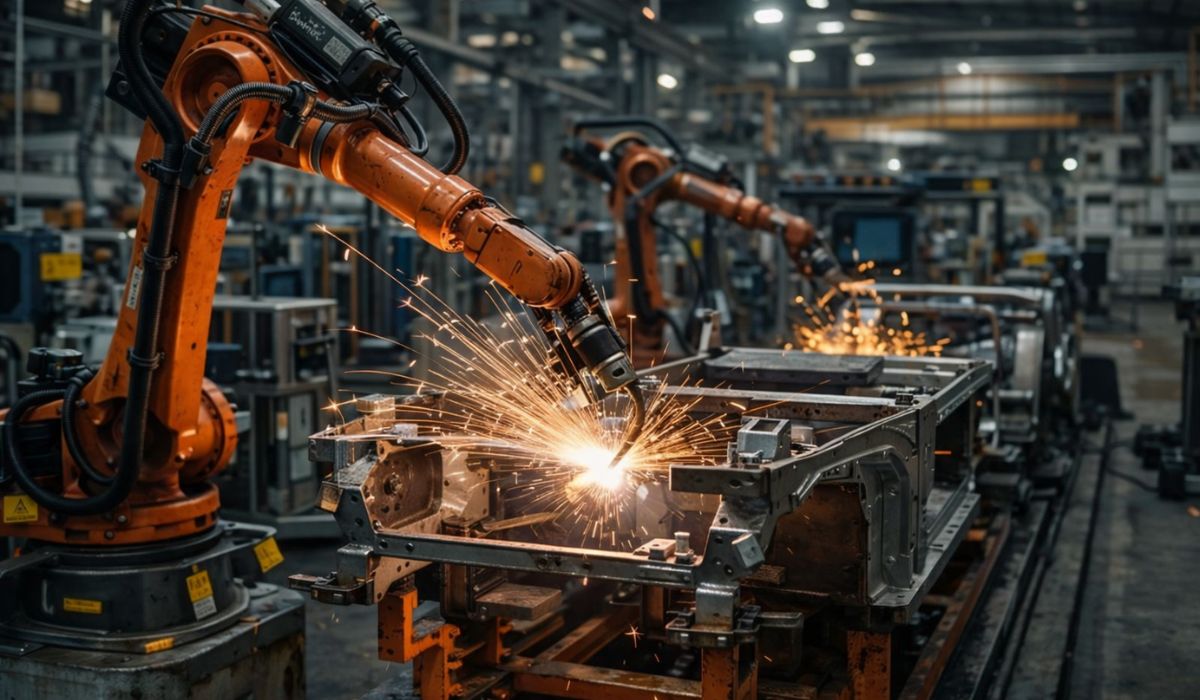
Below are the five most common applications where Indian manufacturers see clear, measurable ROI. Each is presented in a problem-solution-result format.
Application 1: Robotic Welding Automation
Problem: Inconsistent weld quality, high rework, operator fatigue, and dependency on skilled welders who are difficult to find and retain.
Solution: A robotic welding cell with precision fixtures, automated weld path programming, and real-time seam tracking. This can be MIG, TIG, or spot welding depending on your application.
Result: Uniform weld quality across every part, rejection rates dropping from double digits to below 2%, and cycle times reduced by 30 to 50 percent. Most automotive tier-1 suppliers recover their investment within 12 to 18 months.
See our robotic welding automation solutions for automotive and general engineering.
Application 2: Automated Assembly Systems
Problem: Manual assembly errors, slow throughput, and high dependency on experienced assemblers. When a senior assembler leaves, tribal knowledge leaves with them.
Solution: Robotic assembly stations combined with SPMs for pressing, fastening, dispensing, or torque-controlled operations. Vision systems verify correct placement.
Result: Zero-error assembly, consistent throughput regardless of shift, and standardized production that can be replicated across multiple lines. Medical device and automotive electronics manufacturers benefit the most.
Explore our assembly line automation capabilities.
Application 3: Material Handling and Machine Tending
Problem: CNC machines, injection molding machines, or presses sitting idle because operators are slow, distracted, or on break. Safety risks when humans reach into active machines.
Solution: A robotic arm that loads raw material into the machine, unloads finished parts, and signals the machine to start the next cycle. Conveyors and part presenters feed the robot.
Result: Machine utilization increases from 40-60% to 85-90% or higher. Operator safety improves because humans no longer enter the work envelope. If your CNC machine is waiting for an operator, you are losing money every minute.
Application 4: Inspection and Vision-Based Quality Control
Problem: Manual inspection is inconsistent. A human inspector misses defects after the first hour of a shift. High variation leads to customer complaints or downstream rework.
Solution: In-line vision systems using cameras and machine learning algorithms to inspect every single part at full production speed. Sensors measure dimensions, detect cracks, or verify assembly.
Result: Real-time quality control, zero escaped defects, and full traceability. This is critical in aerospace and medical manufacturing where compliance is non-negotiable.
Application 5: Special Purpose Machines (SPMs)
Problem: No off-the-shelf machine can perform your unique process. Standard robots cannot handle the specific motion, force, or environment required.
Solution: A custom-designed SPM that integrates robotics, mechanical systems, pneumatics, hydraulics, and control logic into a single purpose-built machine.
Result: A fully optimized process that runs at maximum efficiency. This is where deep engineering expertise separates real integrators from box-movers. Parc Robotics has delivered dozens of SPMs for automotive BIW, assembly, and testing applications.
View our SPM manufacturing projects.
The Biggest Mistakes Indian Manufacturers Make with Industrial Automation Systems
Experience across hundreds of factory floors reveals the same mistakes repeated.
Mistake 1: Buying a robot before understanding the process
A senior executive visits an automation exhibition. He sees a shiny robotic arm. He buys one. Then he asks his engineers to “make it work.” This almost always fails. The robot ends up underutilized or sold as scrap. The correct approach is to first map the current process, measure cycle times, identify bottlenecks, and then design a system.
Mistake 2: Choosing an integrator based on lowest price
Cheap integrators cut corners. They use refurbished components. They skip proper documentation. They deliver a system that works on day one but fails on day thirty. Your production stops. You pay more in downtime than you saved. Always evaluate integrators on their engineering capability, not their quotation.
Mistake 3: Ignoring integration complexity
A robot is easy. Connecting it to your existing conveyor, PLC, quality system, and MES is hard. Many manufacturers assume the robot supplier will handle integration. They do not. You need a system integrator who owns the entire stack from end to end.
Mistake 4: Expecting ROI within six months
Some processes can pay back quickly, especially robotic tending of a high-value CNC machine. But most industrial robotics automation projects take 1.5 to 3 years to deliver full ROI. If a vendor promises faster without understanding your process, they are guessing. Realistic expectations prevent disappointment.
Common Concerns Before Investing in Industrial Robotics Automation (Objections Handled)
Decision-makers think: “Too expensive. Too complex. Will it actually work in my factory?” Let us address each directly.
Concern 1: “Industrial robotics automation is too expensive for my scale”
Reality: Compare the cost of a robotic system against the cost of not automating. Calculate your annual rejection cost. Calculate overtime and shift allowances. Calculate lost contracts due to inconsistent quality. In most medium-to-high volume Indian factories, the breakeven is 18 to 24 months. After that, the system generates profit.
Concern 2: “Installation will stop my production”
Reality: A good integrator uses phased integration. They design offline, simulate the system, and install during planned shutdowns or weekends. Many systems are built and tested at the integrator’s facility first, then installed in your factory within 3 to 5 days of planned downtime.
Concern 3: “My workers will resist”
Reality: You are not replacing workers. You are redeploying them from dangerous or monotonous jobs to higher-value roles like quality assurance or maintenance. Most workers prefer operating a robot to standing in front of a welding torch for eight hours. Training, not replacement, is the key.
Concern 4: “Our factory environment is too harsh for industrial robotics automation”
Reality: Industrial robots are designed for foundries, welding shops, and dusty environments. With proper ingress protection (IP ratings) and regular maintenance, they outlast human workers. Parc Robotics has installed systems in some of the toughest Indian factory floors – they run reliably.
Still unsure? Request a no-obligation site visit. We will assess your actual floor conditions and tell you honestly if industrial robotics automation fits.
How to Choose the Right Automation Partner in India
Your choice of integration partner determines success or failure more than the robot brand. Here is how to evaluate.
Look for proven industry experience
Ask the integrator: Have you worked in my industry? Do you understand automotive weld quality standards? Have you built SPMs for medical device assembly? Generalists are risky. Specialists deliver.
Check end-to-end integration capability
The right partner should offer concept design, detailed engineering, manufacturing, assembly, installation, and commissioning. If they outsource critical steps, you will face coordination delays and finger-pointing.
Evaluate their problem-solving approach
A good integrator will not sell you a standard package. They will visit your factory. They will study your existing process. They will ask questions about your specific constraints. They will propose a custom solution. If someone gives you a quote without a site visit, be suspicious.
Ask for references and real installations
The best proof is a working industrial automation system in a factory similar to yours. Ask for client references. Better yet, ask to visit an installation. If the integrator hesitates, that is a red flag.
The Parc Robotics Advantage
Parc Robotics has been designing and deploying industrial robotics automation systems in India since 2016. The company is not a robot distributor. It is a systems integrator with deep expertise in robotic welding, automated assembly lines, SPM manufacturing, and BIW (body in white) projects.
Experience with top OEMs
Parc Robotics has executed projects for or alongside Tata, Mahindra, Hero, Honda, and Toyota. These companies have some of the most stringent supplier quality standards in the world. Delivering for them requires technical excellence, reliability, and accountability.
Technocrat leadership
The team is led by engineers with hands-on manufacturing experience. They understand production constraints because they have worked on factory floors. Decisions are made by people who can read a mechanical drawing and write PLC code, not by sales managers.
End-to-end execution
Parc Robotics handles everything from concept design to commissioning. No dependency on third parties. No blame game when something goes wrong. One point of contact. Full accountability.
Practical ROI focus
The company does not push automation for the sake of automation. The question is always: will this solution improve output, reduce cost, and stabilize operations? If the answer is no, they will say so.
See our BIW projects and industrial automation systems portfolio.
Cost vs ROI – The Real Picture
Let us be honest. Industrial robotics automation is not cheap. A single robotic welding cell with tooling and integration can cost between 25 lakhs and 80 lakhs depending on complexity. A full assembly line with multiple stations can run into crores.
But ROI does not come from the robot alone. It comes from:
-
Reduced labour cost over 3 to 5 years
-
Lower rejection and rework (typically 3-10% savings)
-
Higher output from the same floor space (20-50% improvement)
-
Consistent quality that protects your OEM relationships
-
Reduced downtime from labour absenteeism
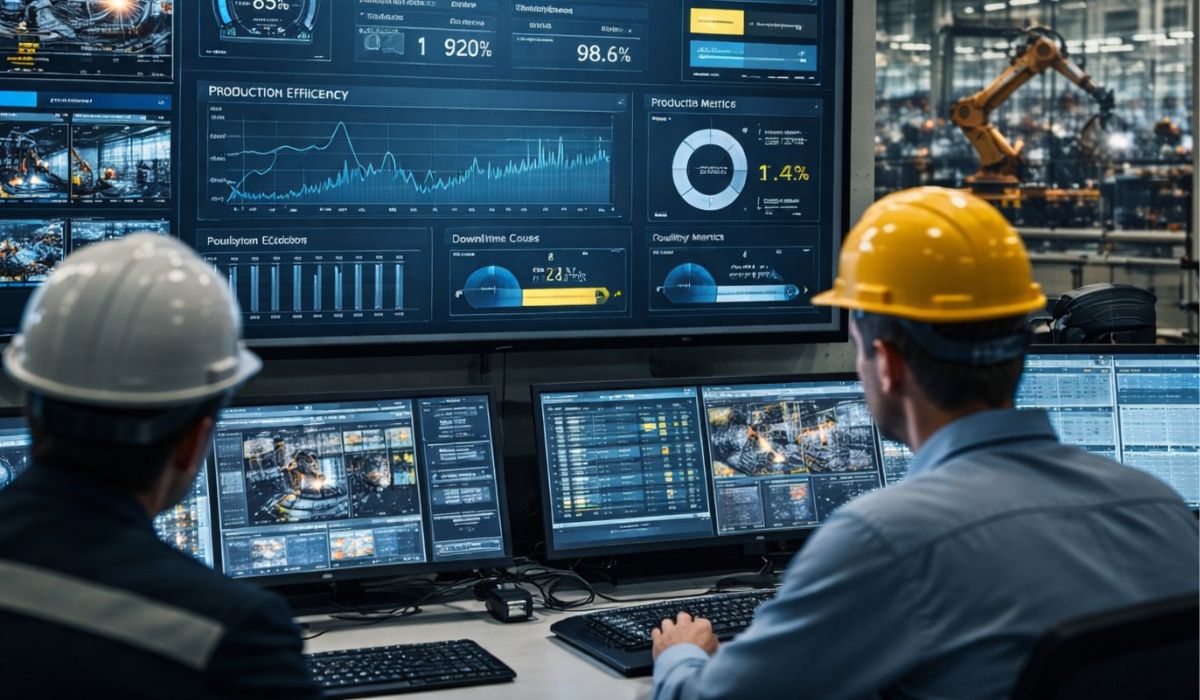
A realistic ROI timeline for most Indian manufacturing applications is 1.5 to 3 years. Some high-volume, high-rejection processes can pay back in 12 months. Others take longer. The key is to calculate ROI based on your specific numbers, not generic promises.
If a vendor guarantees payback in six months without a detailed process study, they are not being honest.
When Should You Invest in Industrial Robotics Automation?
Do not automate blindly. You should seriously consider industrial robotics automation if:
-
Your rejection rate is consistently above 3-5% and manual rework is not fixing it
-
Your production output is inconsistent across shifts or days of the week
-
You are scaling volumes and cannot find enough skilled workers
-
Labour dependency is causing missed delivery deadlines
-
Your CNC machines or other capital equipment are sitting idle due to operator unavailability
If none of these apply, automation may not be your current priority. Focus on improving manual processes first. But if two or more of the above are true, you are already losing money every month that you delay.
Frequently Asked Questions (FAQs) About Industrial Robotics Automation
Q1: What is the typical cost of industrial robotics automation in India?
Costs vary widely based on application complexity. A single robotic welding cell with tooling and integration typically ranges from ₹25 lakhs to ₹80 lakhs. A complete automated assembly line with multiple stations can cost ₹2 crores to ₹5 crores or more. The best approach is to request a process evaluation to get a accurate quote for your specific bottleneck.
Q2: How long does it take to implement an industrial automation system?
From concept to commissioning, most projects take 12 to 20 weeks. This includes design, offline simulation, component sourcing, build, testing at the integrator’s facility, and installation at your factory. Phased integration during planned shutdowns minimizes production disruption.
Q3: Is industrial robotics automation suitable for small and medium factories?
Yes, but only for specific, repetitive, high-volume processes. A small factory with one CNC machine may not justify a robot. However, a small factory producing 5,000+ identical weldments per month can see strong ROI. The decision depends on volume, rejection rate, and labour cost, not factory size.
Q4: Which industries in India benefit most from industrial robotics automation?
Automotive and automotive tier-1 suppliers lead adoption, especially for welding, assembly, and machine tending. Aerospace benefits from precision inspection and assembly. Medical device manufacturing uses automation for clean-room assembly and quality control. General engineering and heavy equipment are also growing adopters.
Q5: Can industrial robotics automation be retrofitted to existing production lines?
Yes. Most of Parc Robotics’ projects are retrofits to existing lines. The key is designing the system to interface with your current conveyors, PLCs, and quality systems. New lines are easier, but retrofits are absolutely feasible and often deliver faster ROI because the bottleneck is already identified.
Conclusion
Industrial robotics automation is not a magic fix. It is a tool. When applied correctly to a well-understood production bottleneck, it delivers higher output, consistent quality, and lower operating costs. When applied without process engineering, it becomes an expensive mistake.
The difference between success and failure is not the robot brand. It is the quality of system design and integration.
If you are facing production bottlenecks, quality issues, or scaling challenges, the next step is not to buy a robot. The next step is to understand your process properly and talk to someone who has built real industrial automation systems in Indian factories.
Parc Robotics has been doing exactly that since 2016. Whether you need robotic welding, an automated assembly line, a custom SPM, or a complete BIW system, the team can help you move from problem to solution.
Ready to Automate Your Production? Get a Process Evaluation.
If you are ready to move forward, here is the next step.
Tell us your biggest production bottleneck. We will reply with a practical automation recommendation within 48 hours.
-
No charge
-
No commitment
-
Just a straight answer from an engineer, not a sales team
Send your production problem – describe your bottleneck, rejection rates, or scaling challenge.
Talk to an engineer, not a sales team.
Parc Robotics – Industrial automation solutions for Indian manufacturing.
📍 India | 📞 [+91 772 005 0057] | ✉️ [sales@parcrobotics.in] | 🌐 parcrobotics.in
Serving automotive, aerospace, and medical device manufacturers since 2016.