
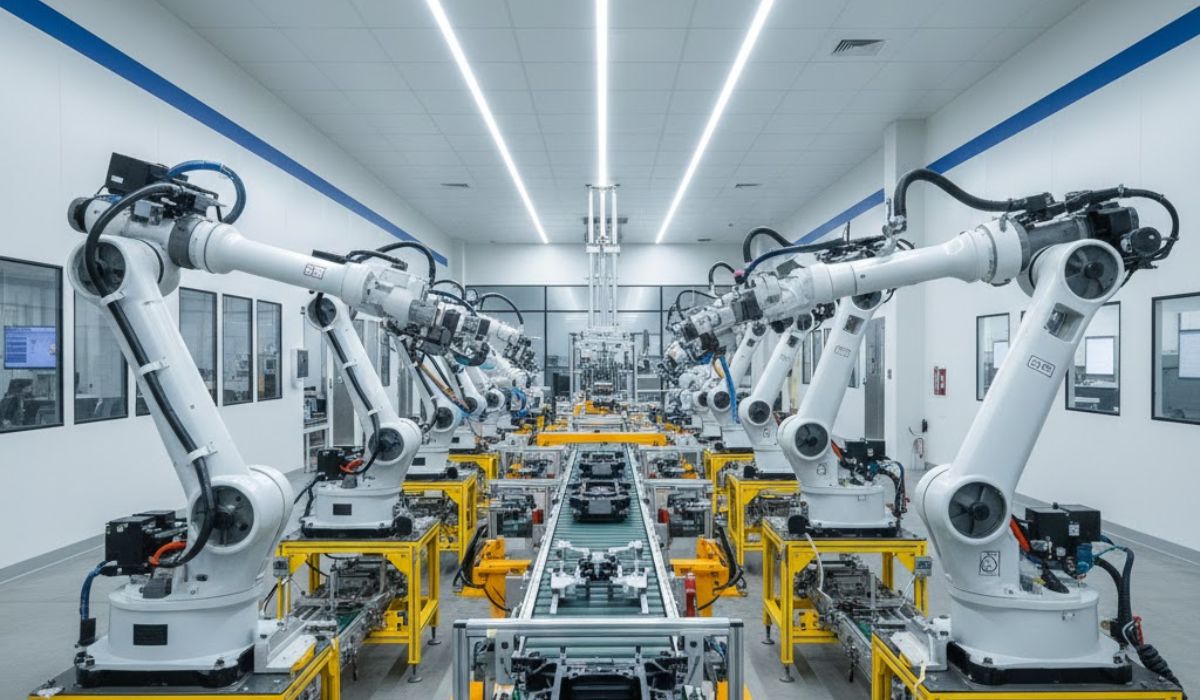
Automotive and electronics manufacturers today face harsh operational realities: rising labour costs, unpredictable workforce availability, and unacceptable quality variation. When margins depend on consistency and speed, manual assembly lines collapse under pressure.
The only sustainable path forward is assembly line automation — replacing repetitive manual work with robotic precision, real-time process control, and continuous output.
An automated assembly line integrates robotics, conveyors, machine vision, and PLC/SCADA control into a synchronized production system engineered for accuracy, speed, and zero-defect performance. If throughput and repeatability define profitability, delaying automation is a strategic failure.
What Is an Automated Assembly Line?
An automated assembly line is a structured, multi-station manufacturing flow where tasks such as assembly, fastening, inspection, testing, and packaging are executed by robotic systems instead of manual operators.
Parts move automatically from station to station using conveyors and transfer units, while a centralized control system coordinates every movement and records performance data.
The result: predictable, repeatable output every hour, every shift, every day — independent of human fatigue or workforce fluctuations.
Why Manufacturing Leaders Are Switching to Assembly Automation
Manual assembly creates operational weaknesses:
-
Output fluctuates by operator and shift
-
Training cycles prevent scaling
-
Handling errors cause scrap and rework
-
Labour dependency slows growth and increases cost
-
100% inspection and traceability are impossible manually
Automation eliminates these variables and builds a stable production foundation based on engineering control, not human tolerance.
Core Technologies Used in Automated Assembly Lines
| Technology | Purpose |
|---|---|
| SCARA / 6-axis / Cartesian Robots | High-precision assembly, fastening, pick-and-place |
| Servo torque & force control | Zero-defect tightening & press-fit processes |
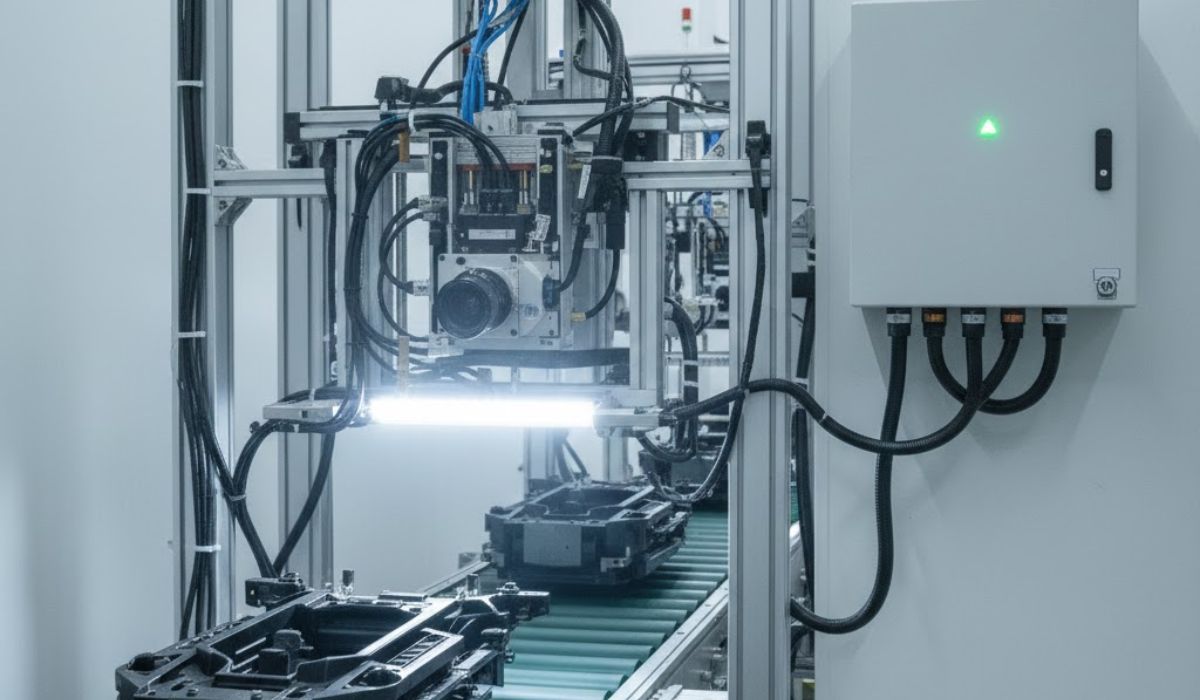
| Vision & sensor systems | Alignment, quality inspection, presence verification |
| Conveyors & transfer mechanisms | Continuous flow between workstations |
| PLC / SCADA control | Process orchestration & live monitoring |
| IoT / AI analytics | Predictive maintenance and optimization |
Automation without data intelligence isn’t automation — it’s just expensive automation equipment.
Types of Assembly Line Automation
| Type | Best Fit |
|---|---|
| Fixed Automation | High-volume, stable products |
| Programmable Automation | Variant-based batch production |
| Flexible Automation | High mix and frequent changeovers |
Selecting the wrong type guarantees wasted investment. Automation strategy must match production mix and growth plans.
Key Benefits of Automated Assembly Lines
1. Faster Production & Higher Throughput
Continuous robotic operation reduces cycle time drastically.
2. Zero-Defect Manufacturing
Vision alignment & force/torque validation remove human error.
3. Reduced Labour Dependency
Predictable output independent of staffing or skill variations.
4. Lower Cost-Per-Unit
Less waste, fewer operators, faster throughput = profitability.
5. Real-Time Production Visibility
SCADA dashboards enable process-level decision-making.
PARC Robotics – Automated Assembly Solutions with Proven ROI
PARC Robotics delivers high-precision automated assembly lines engineered for automotive and electronics environments where repeatability and output reliability control profitability.
We do not sell machinery — we deliver measurable performance improvements.
Real Case Studies & Measurable Outcomes
1. High-Speed EV Battery Module Assembly
Client: EV Manufacturing
Problem: Slow manual module assembly and torque inconsistency risking safety & quality
Solution: Multi-robot workcell with SCARA picking, servo screw-driving, vision alignment, and force monitoring
Outcome:
-
+180% increase in production speed
-
Zero defects with full torque audit trail
-
4 skilled operators freed per shift
2. Precision PCB Testing & Handling
Client: Consumer Electronics Manufacturing
Problem: Handling damage and probe misalignment causing rejection & rework
Solution: XYZ Cartesian gantry system with soft gripper, ESD-safe tooling, automatic pass/fail sorting
Outcome:
-
95% reduction in handling-induced defects
-
40% increase in test station utilization
-
3 operators removed per line
3. Automotive Sub-Assembly Automation
Client: Tier-1 Automotive Supplier
Problem: Multi-step manual assembly creating fatigue & quality variation
Solution: Modular rotary system with robotic dispensing, press-fit, laser marking & inspection
Outcome:
-
640 pieces/hour consistent output
-
70% scrap and rework reduction
-
30% floor space savings
4. Flexible Palletizing Automation
Client: Custom Machinery / FMCG Ancillary
Problem: Slow mechanical changeovers requiring skilled technicians
Solution: Vision-enabled 6-axis palletizing robot with recipe-based HMI
Outcome:
-
Changeover time reduced from 30+ min to under 2 min
-
15% uptime improvement
-
2 manual operators removed per shift
The Bottom Line
Automation is not about replacing people — it is about replacing unpredictability.
Factories choosing automation today gain speed, repeatability, and cost control.
Factories delaying will spend years trying to catch up.
If your business depends on precision and throughput, manual assembly is your most expensive bottleneck.
FAQs – Automated Assembly Line Solutions
Q1. What is an automated assembly line?
An automated assembly line is a production system where machines, conveyors, robots, and control systems work together to assemble components with minimal manual intervention. It improves consistency, speed, and process control.
Q2. Which industries commonly use automated assembly lines?
Automated assembly lines are widely used in automotive, electrical, electronics, consumer goods, and industrial manufacturing sectors where repeatability and production efficiency are critical.
Q3. How does an automated assembly line improve production efficiency?
Automation reduces manual handling, standardizes assembly steps, minimizes errors, and allows continuous operation. This results in higher throughput and more predictable production output.
Q4. Can automated assembly lines be customized for different products?
Yes. Assembly lines can be designed as modular or flexible systems, allowing adjustments for product variations, changes in volume, or future expansion requirements.
Q5. What role do conveyors play in automated assembly lines?
Conveyors move components between stations in a controlled manner. They help maintain consistent flow, reduce handling time, and synchronize operations across the assembly process.
Q6. How is quality ensured in automated assembly lines?
Quality is maintained using sensors, machine vision systems, and in-process checks that inspect components during assembly. This helps detect defects early and maintain consistent standards.
Q7. Are automated assembly lines suitable for low-volume production?
Automation is most effective for medium to high volumes, but modular and semi-automated solutions can also be designed for lower production volumes where flexibility is required.
Q8. What factors should be considered before implementing an automated assembly line?
Key factors include product design, production volume, process complexity, space availability, integration with existing systems, and long-term scalability.
Ready to Automate Your Assembly Line?
📌 Book a Technical Consultation & ROI Analysis
Share your current cycle time, manpower count, and monthly output requirement — we’ll show real payback numbers, not theoretical promises.