
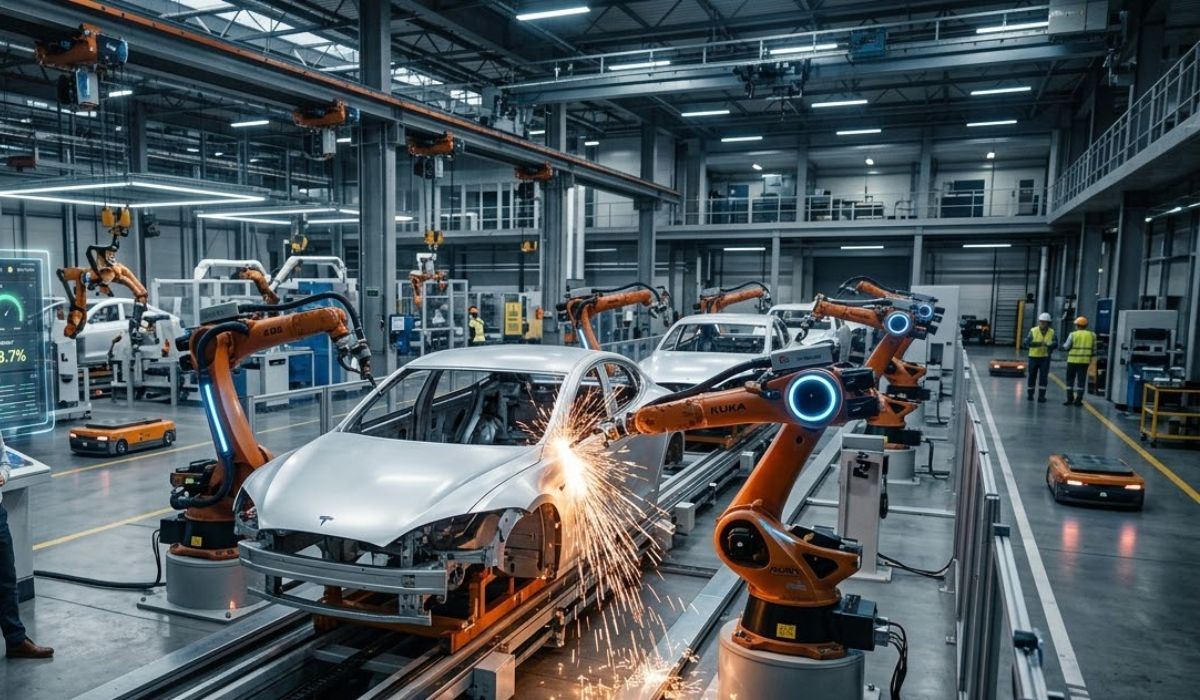
The manufacturing landscape is undergoing its most significant transformation since the industrial revolution. For today’s factory owners and production managers, the pressure to increase efficiency, reduce downtime, and maintain quality is relentless. Manufacturing complexity continues to rise while market demands for faster delivery and customized products intensify.
At the heart of this evolution lies Industry 4.0 Automation Solutions—a paradigm shift that moves manufacturing from simple automation to intelligent, interconnected systems. This digital transformation enables factories to respond to challenges with unprecedented speed and precision.
For companies involved in complex manufacturing, such as automotive body shops and heavy fabrication, understanding smart factory automation is no longer optional; it is a strategic necessity. This guide explains how Industry 4.0 Automation Solutions work, which technologies power smart factories, and how manufacturers can implement these systems to improve efficiency and production reliability.
What Are Industry 4.0 Automation Solutions?
To understand the solution, we must first define the environment. Industry 4.0 represents the fourth industrial revolution, characterized by the fusion of physical assets with digital technologies. In this context, Industry 4.0 Automation Solutions refer to the integration of smart, connected systems that can monitor, analyze, and act upon data without human intervention.
Unlike traditional automation, which relies on pre-programmed, repetitive tasks, manufacturing automation systems leverage real-time data. They allow machinery, robots, and humans to collaborate in a dynamic environment. This is the foundation of digital factory technology, where the entire production line operates as a cohesive, intelligent organism rather than a collection of isolated machines.
Key Technologies Driving Industry 4.0 Automation
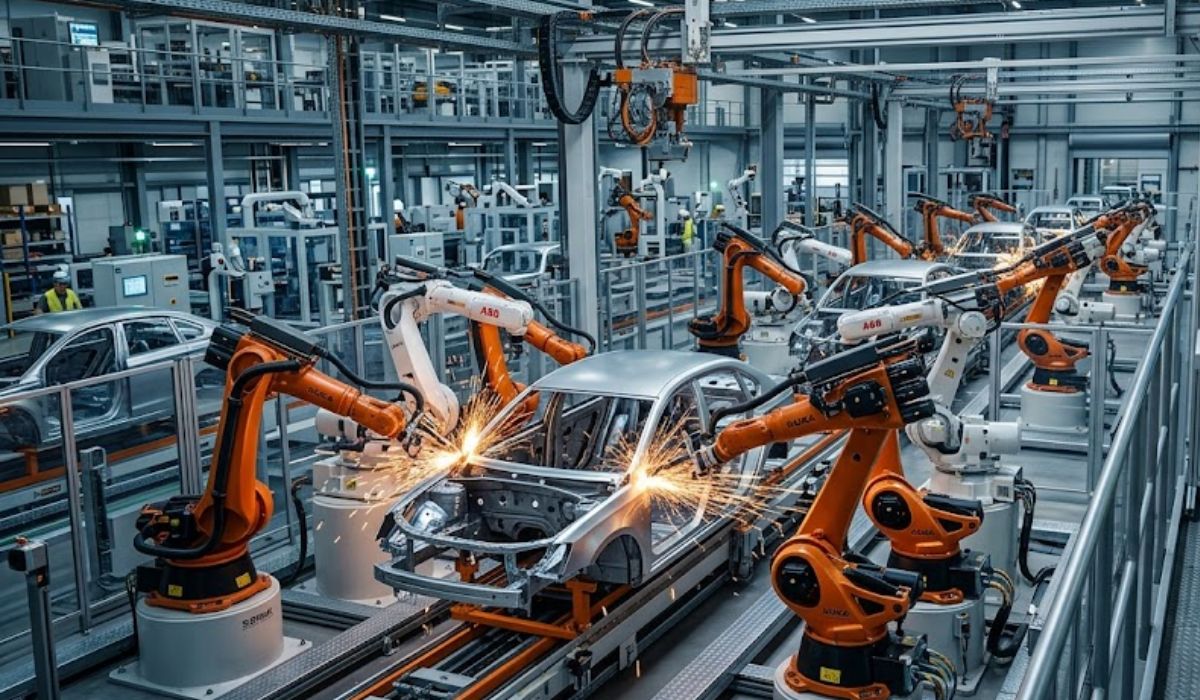
Implementing Industry 4.0 Automation Solutions requires a convergence of several advanced technologies. These are the building blocks that turn a standard production line into a cognitive manufacturing hub.
Industrial Robotics Automation
The modern factory floor is defined by robotics. However, Industry 4.0 takes industrial robotics automation beyond simple pick-and-place operations. Today’s robots are equipped with sensors and connectivity that allow them to communicate with other machines.
Application Insight: For example, in the automotive sector, precision is paramount. Robotic welding systems used in chassis assembly must maintain exact tolerances. Under Industry 4.0, these robots can self-adjust their parameters based on feedback from downstream inspection systems, ensuring weld integrity on every unit.
The Internet of Things (IoT) and Smart Sensors
IoT is the nervous system of the smart factory. By embedding smart sensors in equipment, conveyor belts, and tools, manufacturers can capture a continuous stream of data. These sensors monitor vibration, temperature, and output, providing a live view of the factory’s health. This connectivity ensures that physical processes are mirrored in the digital world, enabling immediate analysis.
Artificial Intelligence (AI) and Machine Learning
Data is useless without intelligence. AI algorithms process the vast amounts of information generated by IoT devices. In industrial automation solutions, AI is used for predictive analytics and quality assurance. Machine learning models can identify microscopic defects in products that the human eye would miss, or optimize production schedules based on supply chain fluctuations.
Predictive Maintenance Systems
Downtime is the enemy of profitability. Predictive maintenance utilizes the data from smart sensors to forecast when a machine is likely to fail. Instead of performing maintenance on a fixed schedule (which is often inefficient) or reacting to a breakdown (which is costly), manufacturing automation systems alert managers to potential issues in advance. This ensures that robotic arms, CNC machines, and assembly line components are serviced only when necessary.
Industry 3.0 vs Industry 4.0: A Comparison
| Industry 3.0 Automation | Industry 4.0 Automation |
|---|---|
| Basic programmable logic | Smart, adaptive systems |
| Isolated machines | Connected production networks |
| Manual monitoring | Real-time data analytics |
| Reactive maintenance | Predictive maintenance |
| Fixed production schedules | Dynamic, demand-driven production |
| Quality sampling | 100% automated inspection |
The Role of Smart Factory Automation in Modern Manufacturing
The smart factory is the physical manifestation of Industry 4.0. It is a facility where smart manufacturing systems are fully integrated, allowing for end-to-end visibility.
In a traditional factory, a bottleneck on the assembly line might go unnoticed for hours until inventory piles up. In a smart factory, the system detects the slowdown instantly. The line automatically reroutes tasks to available workstations, or the MES (Manufacturing Execution System) alerts a supervisor via a mobile device.
Furthermore, the role of digital factory technology extends to BIW automation (Body-in-White). In automotive manufacturing, the Body-in-White stage involves the welding and assembly of the car’s sheet metal frame. With Industry 4.0 Automation Solutions, every weld, rivet, and joint is logged in a digital ledger. This creates a digital twin—a virtual replica of the physical product—that can be analyzed for structural integrity and future recall prevention.
Real-World Applications of Industry 4.0 in Manufacturing
Understanding how smart factory automation applies in real production environments helps clarify their value proposition. Here are specific applications transforming factories today:
Robotic Welding in Automotive Manufacturing
The automotive industry relies heavily on precision welding for structural integrity. Modern robotic welding systems integrated with Industry 4.0 technologies can:
-
Adjust welding parameters in real-time based on material thickness variations
-
Log every weld parameter for quality traceability
-
Communicate with upstream and downstream stations to coordinate production flow
-
Self-diagnose wear in welding tips and schedule replacement automatically
Vision Inspection Systems
Quality control has been revolutionized by AI-powered vision systems. These systems:
-
Detect microscopic defects invisible to the human eye
-
Compare products against digital CAD models with micron-level accuracy
-
Learn from previous defects to identify emerging quality issues before they become systemic
-
Provide statistical process control data to engineering teams
Automated Material Handling and Logistics
Smart factories use autonomous guided vehicles (AGVs) and smart conveyors that:
-
Dynamically reroute materials based on production priority changes
-
Track inventory in real-time, eliminating manual counting
-
Coordinate with production schedules to ensure just-in-time delivery to workstations
-
Reduce workplace injuries by eliminating manual heavy lifting
Industrial Automation Solutions in Modern Production Lines
Integrating these technologies into a cohesive production line requires expert engineering. Modern industrial automation solutions are designed to be modular and scalable.
For instance, consider a production line for heavy machinery. It might feature:
-
Automated Assembly Lines: These are no longer rigid, single-product lines. With Industry 4.0 Automation Solutions, automated assembly lines can switch between product variants seamlessly. When a new chassis enters the line, the system scans its RFID tag, and the robotic tools automatically adjust for the specific model.
-
Collaborative Robotics: While traditional caged robots handle heavy lifting, collaborative robots (cobots) work alongside humans for intricate assembly tasks, using sensors to stop immediately if a human gets too close.
-
Digital Visualization: Human-Machine Interfaces (HMIs) now provide augmented reality views, showing operators the internal status of a machine or highlighting the next assembly step directly on the workpiece.
Implementing Industry 4.0 Automation in Manufacturing
For manufacturers ready to embrace digital transformation, a structured implementation approach ensures success. Here is a proven framework for adopting Industry 4.0 Automation Solutions:
Step 1: Production Process Assessment
Begin by thoroughly analyzing current manufacturing operations. Identify bottlenecks, quality issues, and areas with excessive downtime. This assessment establishes baseline metrics and reveals where automation will deliver the greatest impact.
Step 2: Identify Automation Opportunities
Based on the assessment, prioritize opportunities based on ROI potential. Common starting points include:
-
Repetitive tasks suitable for industrial robotics automation
-
Quality inspection points benefiting from vision systems
-
Material handling operations that can be automated
-
Equipment where predictive maintenance would reduce downtime
Step 3: Integrate Robotics and Smart Sensors
Deploy robotic welding systems, assembly robots, and sensor networks. Ensure all new equipment supports open communication protocols for future integration. At this stage, companies like Parc Robotics design systems that balance automation with flexibility while leveraging advanced industrial robotics automation capabilities.
Step 4: Deploy Data Monitoring Systems
Implement the software infrastructure that collects and analyzes data from the factory floor. This includes MES platforms, data historians, and analytics dashboards that provide real-time visibility into production performance.
Step 5: Continuous Optimization
Industry 4.0 is not a one-time implementation but an ongoing journey. Use the data collected to continuously refine processes, train AI models, and identify new automation opportunities. This creates a cycle of continuous improvement.
Key Benefits of Industry 4.0 Automation for Manufacturers
Studies across advanced manufacturing environments show significant improvements after implementing Industry 4.0 Automation Solutions. Adopting these technologies yields tangible returns that impact the bottom line.
-
Increased Productivity (20-30%): By automating complex tasks and optimizing machine utilization, manufacturers can achieve higher throughput. Systems run 24/7 with minimal human intervention, accelerating time-to-market.
-
Enhanced Quality Control (defect reduction up to 50%): AI-powered vision systems eliminate the variability of human inspection. Real-time monitoring ensures that every product leaving the factory meets strict quality standards, which is critical in automotive and aerospace sectors.
-
Operational Agility: The ability to quickly reconfigure industrial robotics automation for new product runs allows manufacturers to respond to market changes rapidly. Mass customization becomes economically viable.
-
Reduced Downtime (30-50% reduction): Predictive maintenance drastically cuts unplanned stoppages. This ensures that the ROI on expensive capital equipment like robotic welders is maximized.
-
Workforce Safety: By delegating dangerous, repetitive tasks to machines and using sensors to create safe human-robot collaboration zones, workplace injuries decrease significantly.
Challenges in Implementing Industry 4.0 Automation Solutions
While the benefits are compelling, implementing smart manufacturing systems comes with significant challenges. Acknowledging these helps manufacturers prepare realistic implementation roadmaps.
High Implementation Costs
The initial investment for smart factory automation can be substantial. Costs include new equipment with IoT capabilities, sensors and networking infrastructure, software platforms, and integration with existing legacy systems. However, experienced integrators help manufacturers phase implementations to spread investment while delivering value at each stage.
Integration Complexity
Most factories operate with equipment from multiple vendors and vintages. Integrating these disparate systems into a unified Industry 4.0 Automation Solutions framework requires custom interface development, middleware solutions, expertise in multiple communication protocols, and careful planning to avoid production disruptions.
Workforce Training Requirements
The skills required in an Industry 4.0 factory differ significantly from traditional manufacturing. Workers need training in data analysis and interpretation, new human-machine interfaces, troubleshooting connected systems, and collaboration with robotic coworkers.
Cybersecurity Concerns
Connectivity introduces vulnerability. As factories become more connected, they become potential targets for cyberattacks. Robust cybersecurity measures must be integral to any industrial automation solutions implementation.
Industries Leading the Adoption of Smart Manufacturing
While Industry 4.0 applies to virtually every sector of discrete manufacturing, certain industries are at the forefront due to their complexity and high-value outputs.
-
Automotive: This sector is the biggest driver of BIW automation and robotic welding systems. The need for precision and speed in assembling vehicle frames makes automotive a natural fit for smart manufacturing systems.
-
Aerospace: Manufacturing aircraft components involves zero tolerance for error. Industry 4.0 Automation Solutions provide the traceability and precision needed for safety-critical parts.
-
Electronics: The miniaturization of components requires the accuracy of smart assembly lines.
-
Heavy Equipment & Fabrication: For manufacturers of agricultural or construction equipment, manufacturing automation helps manage the production of large, heavy parts with consistency.
The Future of Smart Manufacturing and Digital Factories
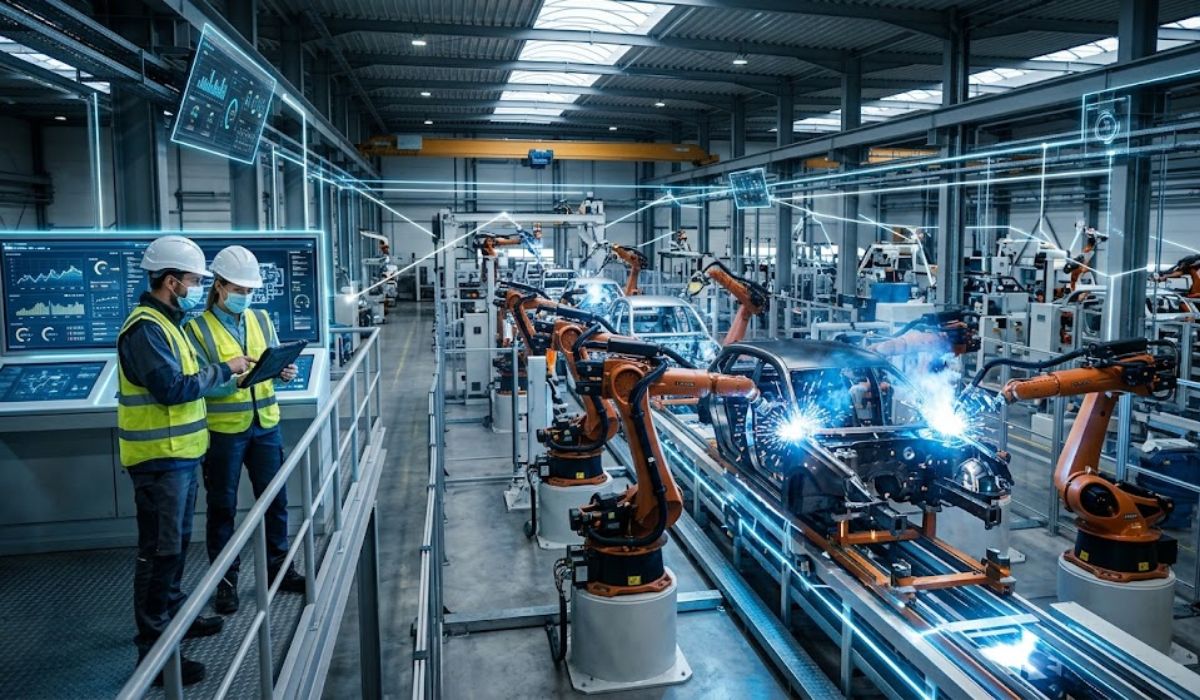
Looking ahead, the evolution of Industry 4.0 Automation Solutions points toward the fully autonomous “lights-out” factory, where production can run for extended periods without human presence.
The digital factory concept will become the standard. Every physical asset will have a digital twin, allowing manufacturers to simulate production scenarios, train AI models, and troubleshoot problems in a virtual space before touching the physical line.
We will also see the rise of edge computing, where data processing happens directly on the factory floor rather than in the cloud. This reduces latency, allowing for instantaneous decision-making in critical processes like robotic welding, where millisecond adjustments matter.
Additionally, 5G connectivity will enable:
-
Massive sensor networks with minimal latency
-
Remote operation of equipment from anywhere in the world
-
Enhanced mobile robotics with real-time navigation
-
Augmented reality support for maintenance and training
Frequently Asked Questions About Industry 4.0 Automation Solutions
What are Industry 4.0 automation solutions?
Industry 4.0 Automation Solutions refer to the integration of smart, connected technologies including industrial robotics, IoT sensors, artificial intelligence, and data analytics into manufacturing processes. These solutions enable real-time monitoring, predictive maintenance, and autonomous decision-making in production environments.
What is a smart factory?
A smart factory is a manufacturing facility where smart manufacturing systems are fully integrated, allowing machines, systems, and humans to communicate and collaborate. It uses real-time data to optimize production, predict maintenance needs, and ensure quality throughout the manufacturing process.
How do robotics improve manufacturing automation?
Industrial robotics automation improves manufacturing by performing repetitive tasks with consistent precision, operating continuously without fatigue, adapting to different product variants through programming, and integrating with sensors and vision systems for quality control.
What is the role of IoT in Industry 4.0?
IoT (Internet of Things) provides the connectivity layer for Industry 4.0 Automation Solutions. Smart sensors collect data from equipment, products, and environments, enabling real-time monitoring, predictive analytics, and automated responses to changing conditions.
How does Industry 4.0 improve manufacturing efficiency?
Industry 4.0 improves efficiency through reduced downtime via predictive maintenance (30-50% reduction), optimized production scheduling using AI, real-time quality control that catches defects immediately, and flexible automation that allows rapid product changeovers.
Which industries use Industry 4.0 technologies?
Automotive manufacturing leads in adopting BIW automation and robotic welding systems. Aerospace, electronics, heavy equipment, pharmaceuticals, and food processing industries also increasingly implement smart factory automation to improve quality and productivity.
What technologies are used in smart factories?
Smart factories combine industrial robotics automation, IoT sensors, AI and machine learning, cloud computing, edge processing, digital twins, augmented reality, and advanced vision inspection systems. These technologies work together to create connected, intelligent production environments.
What is the difference between Industry 3.0 and Industry 4.0?
Industry 3.0 introduced basic automation and programmable logic controllers. Industry 4.0 adds connectivity, intelligence, and data exchange. While Industry 3.0 machines followed fixed programs, Industry 4.0 systems learn, adapt, and communicate across the entire production ecosystem.
How much does Industry 4.0 implementation cost?
Costs vary widely based on factory size, existing equipment, and implementation scope. However, experienced integrators offer phased approaches that allow manufacturers to realize returns at each stage while spreading investment over time.
What is the future of smart manufacturing?
The future includes fully autonomous factories, widespread digital twins, edge computing for real-time decisions, 5G connectivity enabling massive sensor networks, and AI systems that continuously optimize production based on demand and conditions.
Conclusion
The transition to Industry 4.0 Automation Solutions is a journey, not a destination. It requires a strategic overhaul of how manufacturing is approached. For companies specializing in high-stakes production—from robotic welding systems to complex automated assembly lines—embracing these technologies is essential for staying competitive.
By implementing robust industrial automation solutions that leverage IoT, AI, and advanced robotics, manufacturers can build a factory that is not only automated but truly intelligent. Whether you are looking to upgrade an existing facility or build a new greenfield smart factory, the principles of smart factory automation provide the roadmap to a more efficient, reliable, and profitable future.
The future of manufacturing belongs to those who embrace digital transformation. As technology continues to evolve, the gap between traditional factories and smart factories will widen. Manufacturers who invest in Industry 4.0 Automation Solutions today position themselves as leaders in their industries, capable of meeting tomorrow’s challenges with confidence and capability.
For manufacturers ready to take the next step, partnering with experienced automation providers ensures that digital factory technology is implemented effectively, delivering maximum return on investment while positioning your facility for the future of manufacturing.