
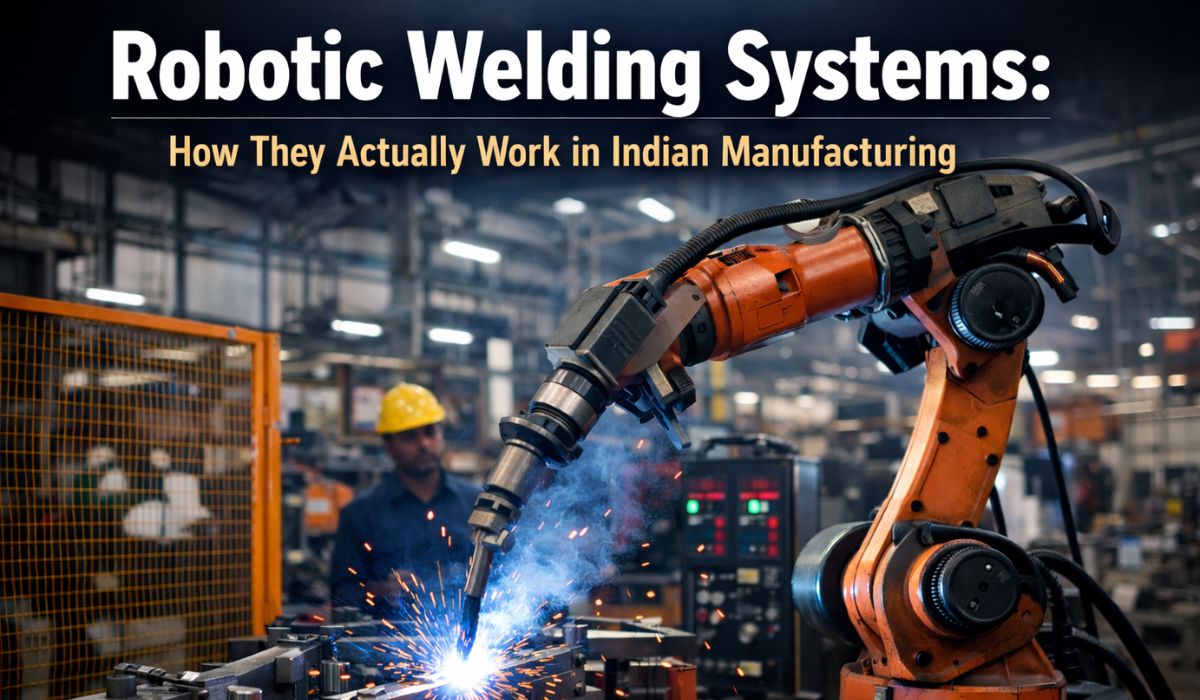
For manufacturing engineers, production managers, and plant heads across India, robotic welding presents a compelling proposition. It promises higher throughput, consistent quality, and reduced dependency on skilled welders. However, the journey from procurement to profitable operation is often misconstrued. The common perception is of a plug-and-play solution: install a robot, program a path, and reap the benefits. This view is not only simplistic but also the primary reason many automation projects underperform or fail on the Indian shop floor. Robotic welding is not an appliance. It is a complex, integrated system whose success depends entirely on the stability of its inputs and the synergy of its components. This article dissects the reality of these systems within the context of Indian manufacturing.
A Robotic Welding System Is Not Just a Robot
The robot arm, the most visible element, is just one part of the ecosystem. Its performance is governed by, and contingent upon, every other component. A failure in any link breaks the chain. The core system comprises:
-
The Robot and Controller: The mechanical arm provides motion. The controller is its brain, executing the programmed path and logic. Its precision is meaningless if the part is not positioned precisely.
-
The Welding Power Source and Wire Feeder: This is the actual “welder.” The choice of process (MIG/MAG, TIG, Sub-Arc), the quality of the arc characteristics, and the consistency of wire feed are paramount. The robot merely positions the torch; the power source creates the weld.
-
The Torch and Consumables: The robotic torch, with its neck geometries and consumables (nozzle, tip, gas diffuser), must be selected for the application. Its maintenance schedule directly impacts arc stability and spatter.
-
The Workholding Fixture: This is arguably the most critical and under-engineered component in Indian applications. It must locate and clamp the part with repeatable accuracy, often within fractions of a millimeter, for every cycle. It also must withstand sustained heat, spatter, and mechanical stress.
-
Safety Systems: Physical fencing, light curtains, and safety interlocks are non-negotiable. They protect personnel and allow for predictable cell operation.
-
Infrastructure: This includes stable electrical power (with protection from voltage fluctuations), clean, dry compressed air for tooling, and effective fume extraction.
The interdependency is absolute. A high-precision robot cannot compensate for a fixture that allows 2mm of part variation. A sophisticated pulsed welding waveform is wasted if the wire feed mechanism jitters due to poor maintenance.
Why Robotic Welding Struggles on Indian Shop Floors

Global automation templates often stumble when faced with ground realities in India. The challenges are systemic.
-
Part Variation: This is the most significant hurdle. Robotic welding assumes part repeatability. In many Indian manufacturing streams, component dimensions can vary due to inconsistencies in upstream processes like cutting, bending, or machining. The robot will blindly weld the programmed path, leading to defects if the joint gap or position shifts.
-
Inconsistent Upstream Processes: Automation is only as stable as the least stable process before it. Manual fit-up before welding, variations in incoming raw material, and lack of process control in preceding stages create a volatile input for a system designed for consistency.
-
Power and Maintenance Constraints: Voltage sags and surges can disrupt controllers and power sources. Interruptions in compressed air supply can affect clamping. A culture of reactive, rather than preventive, maintenance leads to gradual cell degradation—dirty torch nozzles, worn fixture locators, and slipping calibration.
-
Skill Gaps: The need shifts from skilled welders to skilled technicians who understand robotics, programming, welding metallurgy, and maintenance. This hybrid skill set is scarce. Over-dependence on the system integrator post-installation is common, crippling in-house troubleshooting and optimization.
Key Components That Decide Performance
Understanding where to focus engineering effort is crucial.
-
Robot & Controller: The focus should be on reach, payload, and suitability for the environment (dust, spatter). For welding, most articulated robots from major brands are capable. The greater limitation often lies in the programming logic—creating efficient, collision-free paths and integrating sensor feedback for seam tracking.
-
Welding Power Source: Selecting the right process and a power source with robust synergic lines and adaptive features is vital. A source with good anti-stick and hot-start functions can mitigate some minor fit-up issues. It must be chosen for the specific material and weld quality requirement.
-
Fixtures as a Critical Success Factor: Fixtures must be designed for the actual part, not the CAD model. They must account for part tolerances, thermal distortion, and spatter management. Quick-change clamps and standardized locators are essential for cells running multiple part families. This is where the largest portion of system engineering effort should be allocated.
-
Safety and Workcell Layout: The cell must be designed for efficient material flow—easy loading/unloading for the operator. Ergonomic fixture height and clear separation of manual and automated zones prevent bottlenecks and safety hazards. The robot’s work envelope should be utilized optimally, not just for welding but for torch cleaning station access.
Where Robotic Welding Systems Commonly Fail
Failure is rarely about the robot itself. It is about system thinking.
-
Wrong Application Selection: Automating a complex, low-volume assembly with many short, discontinuous welds is often less productive than skilled manual work. Robots excel at long, continuous welds on repeatable parts.
-
Over-Automation: Attempting to fully automate a process that still requires frequent manual intervention for fit-up or inspection creates a complex, expensive cell that is fragile and difficult to manage.
-
Copy-Paste Cell Designs: Implementing a cell design from a European or Japanese plant without adapting for higher part variation, different material flow, or local maintenance practices is a recipe for failure.
-
Ignoring Tolerance Variation: Proceeding without a statistical understanding of part variation, and not implementing compensatory measures (like touch sensing or through-arc tracking) where necessary, leads to consistent quality failures.
When Manual Welding Is Still the Better Option
Robotic welding is not a universal solution. It remains inferior to manual welding in specific scenarios common in India:
-
Low Volume, High Mix Production: Where changeover time would exceed welding time.
-
Poor Part Consistency: Where joint location varies beyond the compensation range of sensors.
-
Highly Complex or Restricted Access Joints: That require constant human judgment and adaptation.
-
Extremely Cost-Sensitive Operations: Where the capital expenditure cannot be justified by the throughput or quality gains, or where labor costs remain comparatively low.
Integration Is the Real Engineering Challenge
The hardware is commoditized. The true engineering lies in integration—the seamless coordination of all components into a reliable production unit. This means:
-
Fixture-Robot Coordination: The fixture design must present the weld seams within the robot’s optimal reach and orientation.
-
Process-Path Coordination: The welding parameters (voltage, current, travel speed) must be perfectly synchronized with the robot’s programmed path. A change in wire feed speed must correspond to a change in travel speed.
-
Cycle Time Optimization: The entire cycle—load, clamp, weld, unclamp, unload—must be balanced. Shaving seconds off the weld path is futile if the fixture takes minutes to load.
This integration discipline is what separates a functioning cell from a high-uptime, high-return asset.
Indian Manufacturing Context: Why Global Templates Fail
Global automation strategies are predicated on standardized processes and consistent inputs. The Indian manufacturing landscape, particularly in the SME sector which is the backbone of industry, is different. It is characterized by adaptability, flexibility, and often, supply chain variability. A rigid, high-precision automation template will clash with this reality. Success requires a context-aware system design. This might mean:
-
Designing fixtures with adjustable locators to accommodate a defined range of part variation.
-
Prioritizing robustness and serviceability over cutting-edge sophistication in component selection.
-
Implementing basic seam tracking as a standard feature, not an optional extra.
-
Planning for manual fit-up stations within the cell workflow where necessary, rather than attempting full automation.
The system must be designed for the plant as it exists, with a clear roadmap for stabilizing upstream processes, not for an idealized version of it.
Decision Framework: Is Robotic Welding Worth It?
The question is not a simple yes or no. It is a multi-stage assessment of readiness.
-
Process Stability Audit: Before considering a robot, audit the consistency of your parts. Measure variation in cut lengths, bend angles, and fit-up gaps. Can this variation be reduced or controlled cost-effectively? If not, can the robotic system be designed to handle it?
-
Volume and Variability Analysis: Is the volume sufficient to justify the capital outlay? Is the part family similar enough to allow for logical fixturing and programming?
-
Internal Readiness: Do you have, or can you develop, the in-house competency to program, maintain, and troubleshoot the system? Is management committed to the disciplined, preventive maintenance culture it requires?
-
Total Cost of Ownership View: Look beyond the capital cost. Factor in fixture costs, maintenance contracts, training, and potential line rebalancing. Weigh this against the tangible benefits: predictable output, material savings from reduced rework, and the ability to redeploy skilled welders to more value-added tasks.
-
Long-Term Planning: The goal should not be to automate a problematic process, but to solve the process problems and then automate. The investment should be part of a longer-term operational excellence strategy.
Conclusion
The successful implementation of a robotic welding system in an Indian manufacturing unit is a testament to systems engineering, not just to capital expenditure. It forces a discipline of process control that often yields benefits far beyond the welding station itself. The robot is not a magician. It is a highly repeatable motion device that amplifies the consistency of its inputs. A well-integrated system, designed for local conditions with robust fixtures and a clear understanding of its limitations, becomes a formidable competitive advantage. Conversely, a robot installed in isolation, into an unstable process, becomes a very expensive, and very public, monument to failed expectations. The difference lies not in the hardware purchased, but in the depth of systemic thinking applied before the first component is ever ordered.