
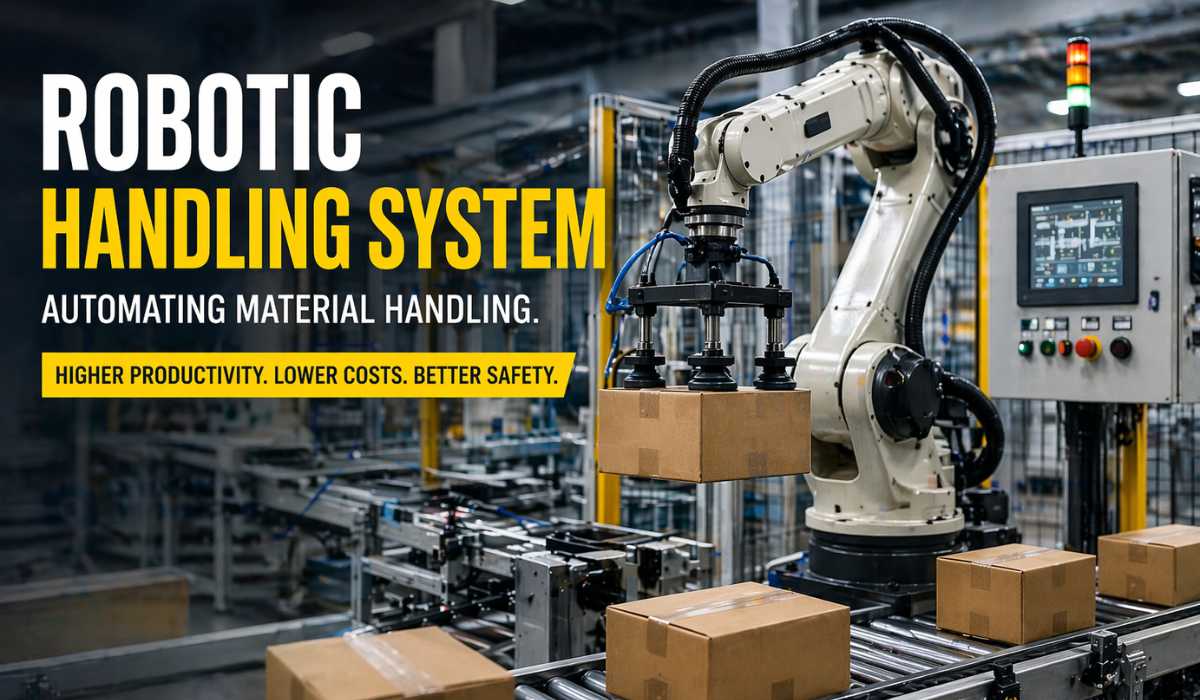
Labor is getting expensive. Errors are getting costly. And production targets are getting tighter.
If your factory still depends heavily on manual material handling, you’re already behind.
A robotic handling system (also called a robotic material handling system or automated handling system) solves this by automating how materials are moved, picked, placed, and transferred inside a production environment.
What is a robotic handling system?
A robotic handling system is an automated industrial setup that uses robots, sensors, and control systems to move, pick, place, or transfer materials with high speed, accuracy, and consistency inside manufacturing or warehouse environments.
It is widely used in:
-
Automotive manufacturing
-
Electronics assembly
-
FMCG packaging
-
Pharmaceutical production
-
Warehousing and logistics
The business goal is simple: reduce labor cost, eliminate human error, and increase output without increasing manpower.
Who needs this?
-
Plant managers facing high attrition
-
SME owners struggling with quality consistency
-
Operations heads looking to scale without adding shifts
-
Warehouse operators dealing with rising labor costs
If any of the above sounds familiar, read on.
Key Components of a Robotic Handling System
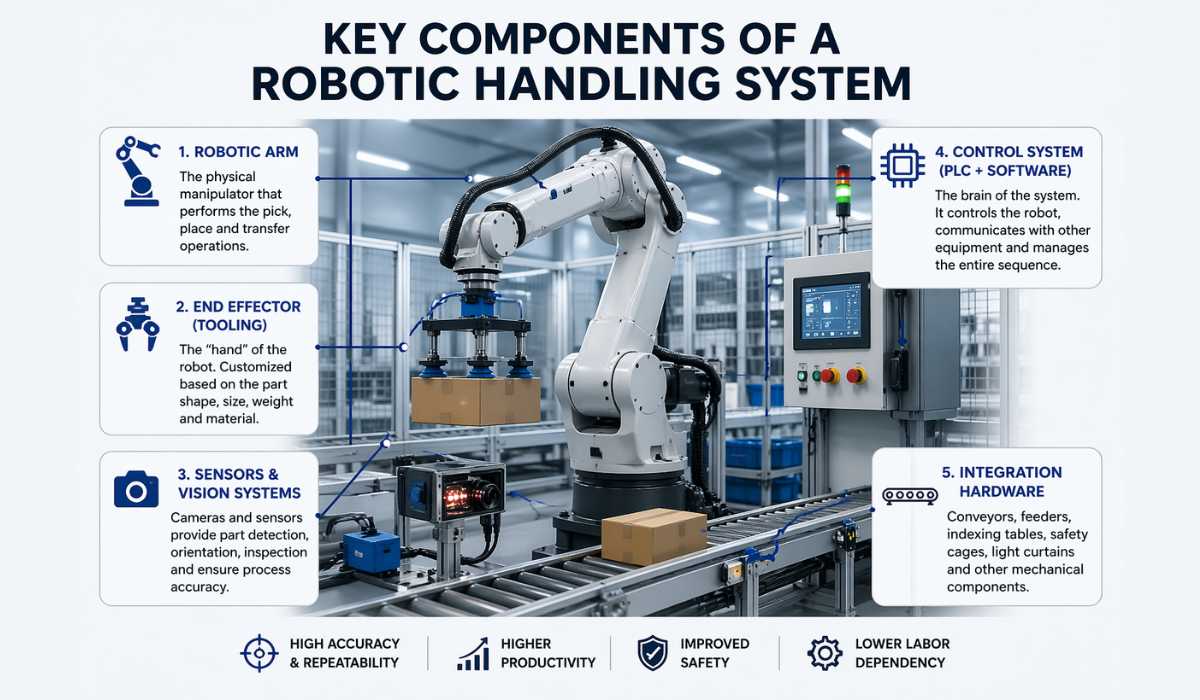
A complete industrial handling robot system is more than just a robot arm. Here’s what goes into a production-ready setup:
1. Robotic Arm
The physical manipulator. Common configurations:
-
Articulated (6-axis) – Most flexible, for pick & place, welding, assembly
-
SCARA (4-axis) – Fast horizontal moves, ideal for electronics
-
Delta – Ultra-fast lightweight picking (food, pharma)
2. End Effectors (Tooling)
The “hand” of the robot. Types:
-
Pneumatic grippers (for boxes, metal parts)
-
Vacuum suction cups (for flat surfaces, glass, PCB)
-
Magnetic grippers (ferrous materials)
-
Custom EOAT (e.g., dual grippers for cycle time reduction)
System integrators like Parc Robotics often design custom EOAT to handle irregular product shapes.
3. Sensors & Vision Systems
-
2D/3D cameras for part localization
-
Force/torque sensors for delicate assembly
-
Proximity and safety sensors
4. Control System (PLC + Software)
-
PLC coordinates robot with conveyors, feeders, and other machines.
-
Robot teach pendant or offline programming software.
5. Integration Hardware
-
Conveyors, indexing tables, part feeders, safety cages, light curtains.
Types of Robotic Handling Systems
| Type | Typical Application |
|---|---|
| Pick and Place | Transfer parts from conveyor to tray |
| Material Handling | Move raw materials between workstations |
| Palletizing/Depalletizing | Stack boxes or bags on pallets |
| Assembly Line Handling | Present parts to assembly stations |
| Warehouse Automation | Bin picking, kitting, order consolidation |
Applications Across Industries (India Context)
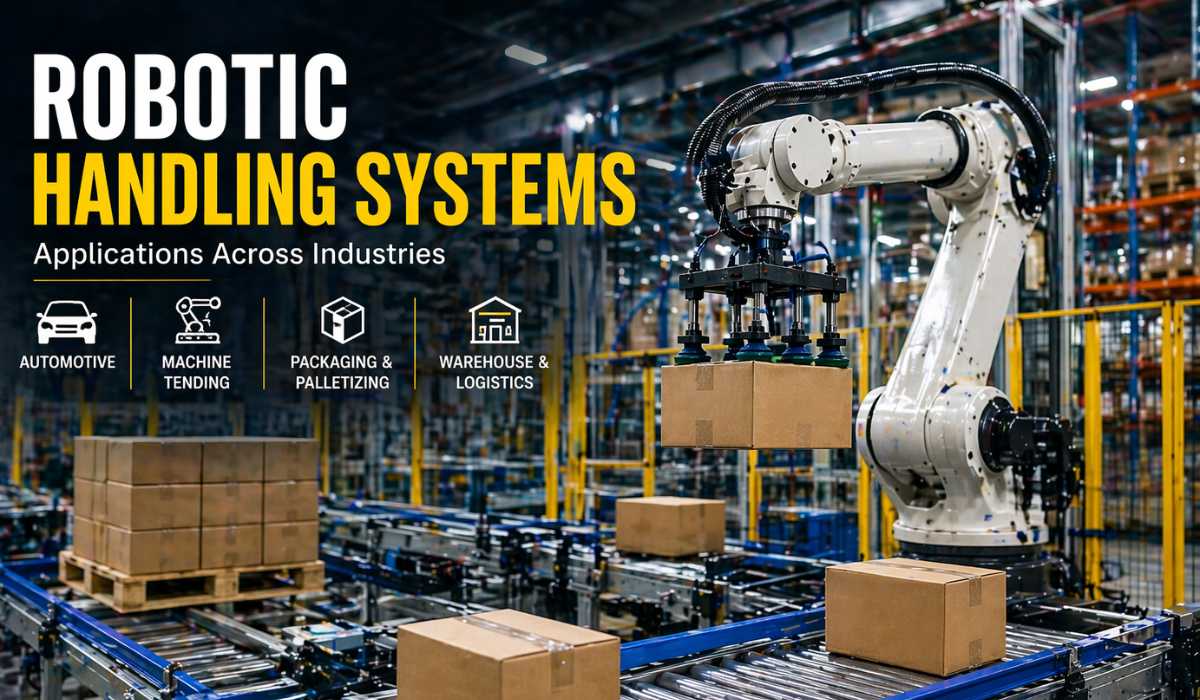
Automotive
-
Loading/unloading CNC machines (gears, shafts)
-
Handling car doors and windshields
-
Welding + handling integration
Realistic example: A Pune-based Tier-2 supplier reduced machine idle time by 37% using a 6-axis robotic material handling system for CNC tending.
Electronics
-
Delicate PCB handling
-
Battery cell placement
-
Smartphone display assembly
FMCG
-
Primary packaging (biscuits into trays)
-
Secondary packaging (cartons into cases)
-
High-speed pick & place (150+ picks/minute)
Pharmaceuticals
-
Cleanroom-compatible handling
-
Syringe filling line transfer
-
Blister pack loading
Warehousing & Logistics
-
Mixed-case palletizing
-
Returns sorting
-
E-commerce bin picking
Benefits of Robotic Handling Systems (With Realistic Numbers)
-
Productivity increase: 30–50% cycle time reduction
-
Accuracy: ±0.05 mm repeatability, zero dropped parts
-
Cost reduction: ₹3–6 lakh labor savings per robot per year (2 shifts)
-
Safety: Eliminates lifting >15 kg repeatedly
-
Scalability: Reprogram for new products in hours, not weeks
Typical ROI in India: 12 to 24 months
Challenges and Limitations (No Brochure Talk)
| Challenge | Reality Check |
|---|---|
| High initial cost | ₹15–40 lakh for a complete cell |
| Integration complexity | Existing conveyors may need mods |
| Maintenance | AMC typically 5–8% of capital cost |
| Skilled workforce | At least one trained technician required |
Most automation failures in India are not due to robot quality—but due to poor system integration and unrealistic expectations.
Without proper integration, even a ₹20–30 lakh robot can become a bottleneck instead of improving productivity.
For Indian SMEs: The skill gap is real. Partner with an integrator that offers on-site training and remote support.
How to Choose the Right Robotic Handling System
1. Load Capacity
Part weight + gripper weight + 20% margin. Ranges: 3kg to 120kg+
2. Speed Requirements
Pick & place: cycles per minute (e.g., 60 cpm). Match to your line rate.
3. Workspace & Reach
Articulated robots: 500mm to 3,000mm. Use 3D simulation first.
4. Industry-Specific Needs
-
Food/pharma: stainless steel, IP69K washdown
-
Electronics: ESD-safe grippers
5. ROI Calculation (Simple Formula)
(Labor cost saved per year + quality loss reduction) ÷ (Robot + integration cost) = Payback years
Example (Indian SME):
Robot cell cost: ₹25 lakh
Annual labor savings (3 workers x ₹2.5 lakh): ₹7.5 lakh
Scrap reduction saving: ₹2 lakh
Total annual benefit: ₹9.5 lakh
Payback: 2.6 years
6. Integration Partner Checklist
-
Ask for similar industry references
-
Do they offer offline programming?
-
Post-installation support SLA?
Future Trends in Robotic Handling Systems
-
AI integration: Vision-based bin picking reduces programming time by 70%
-
Smart factories: Robots report OEE, wear, and deviations in real time
-
Vision-based robotics: 3D cameras + deep learning for mixed SKUs
-
Collaborative handling: Cobots work safely next to humans
In India, these trends will first appear in automotive and electronics clusters (Pune, Chennai, Noida, Bengaluru).
Why Indian Businesses Are Adopting Robotic Handling Systems Now
-
Labor cost vs automation shift: Wages rising, attrition 15–25% annually
-
Make in India push: PLI schemes require quality and scale
-
Manufacturing growth: PMI above 55 for two years → more volume = more handling
Forward-thinking plants are now working with experienced integrators such as Parc Robotics that design robot material handling solutions specifically for Indian factory conditions—handling dust, voltage fluctuations, and operator skill variability.
Should You Invest in a Robotic Handling System?
If your factory has:
-
Repetitive handling tasks
-
2+ workers per shift doing the same movement
-
Quality variation due to manual errors
Then automation is not optional anymore—it’s a cost decision.
FAQs: Robotic Handling Systems
Q1. What is the cost of a robotic handling system in India?
A basic system starts from ₹15 lakh and can go up to ₹40+ lakh depending on payload, complexity, and integration requirements.
Q2. What is the ROI of robotic handling systems?
Most Indian manufacturers achieve ROI within 12–24 months through labor savings, reduced scrap, and higher productivity.
Q3. Which industries use robotic handling systems the most?
Automotive, electronics, FMCG, pharmaceuticals, and warehousing industries are the primary adopters.
Q4. Do robotic systems require skilled operators?
Yes. At least one trained technician is needed for programming and maintenance.
Q5. Is robotic handling suitable for small factories?
Yes, especially for repetitive, high-volume tasks where labor dependency is high.
Conclusion
A robotic handling system is no longer a luxury for large corporations. Indian SMEs and mid-sized plants can achieve payback within two years when the right components, integration approach, and application are matched.
Key takeaways:
-
Start with a clear ROI calculation
-
Prioritize integration and training over robot brand
-
Plan for maintenance and skill development from day one
Next step: Map one repetitive, high-volume handling task in your plant. Calculate hours per week spent on it. Then speak to an integrator about a pilot cell.
In the next 3–5 years, factories that automate handling will scale faster, operate leaner, and compete globally. Those that don’t will struggle with cost, consistency, and workforce dependency.
Related Info –
Industrial Robotics Automation for Indian Factories: Cost, ROI & Real Use Cases
Robotic Palletizing Solutions in End-of-Line Automation
Industry 4.0 Automation Solutions for Smart Manufacturing