
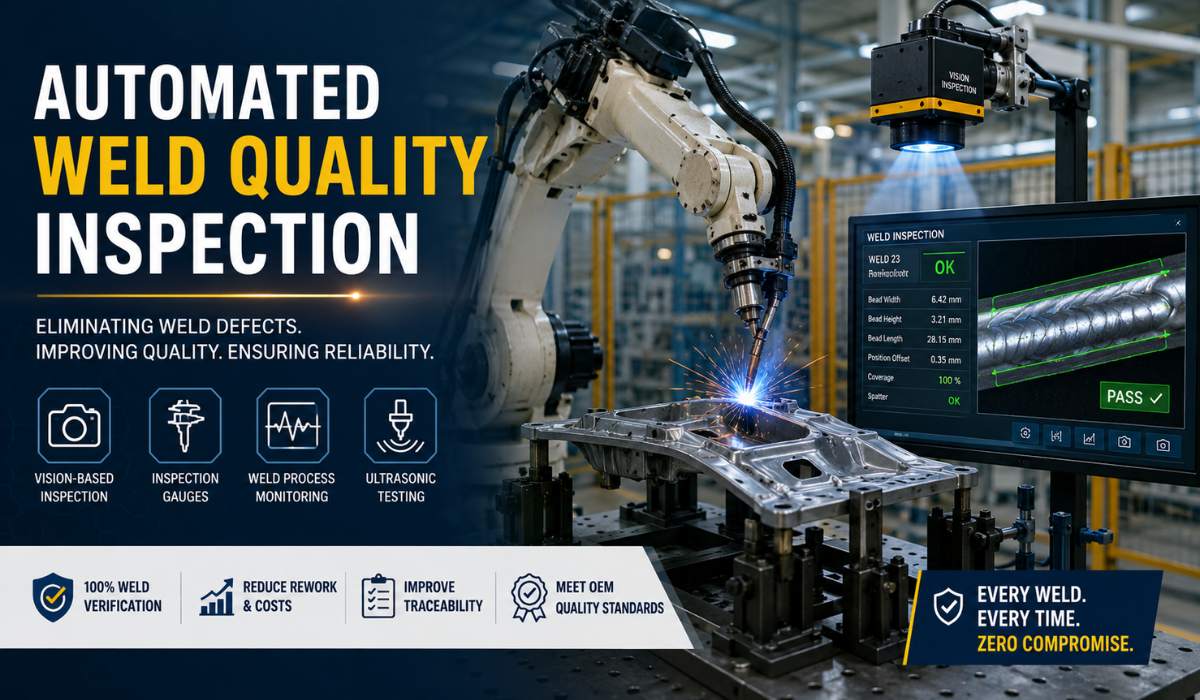
Your welding robot can produce a perfect weld every cycle. But how do you know it did? Automated weld quality inspection is the answer most Indian plants are missing — and it’s why defects still reach the customer even after automation.
Table of Contents
- The Inspection Gap in Indian Welding Operations
- Types of Weld Defects That Manual Inspection Misses
- Methods of Automated Weld Quality Inspection
- Why 100% Weld Inspection Is Becoming Standard
- Implementing Weld Inspection in an Existing Line
- The Business Case for Weld Inspection Automation
- Vision Inspection vs Other Inspection Methods
- PARC Robotics — Inspection Gauges and Automated Quality Systems
- Conclusion
- FAQs
The Inspection Gap in Indian Welding Operations
Most Indian manufacturing plants that have invested in robotic welding systems have solved the problem of weld execution — the robot consistently follows the programmed path. But they haven’t solved the problem of weld verification. Inspection is still largely manual — a QC inspector with a gauge, a visual check, and a sampling plan that misses most defects.
This creates a dangerous gap. The welding robot is consistent. But the fixture can wear over time, allowing slight part misalignment. A torch tip can degrade, affecting arc stability. Wire feed can become inconsistent. None of these changes are visible to a manual inspector doing 5% sampling. They’re only caught when a defective batch reaches the OEM.
Automated weld quality inspection closes this gap by making every weld verifiable — not sampled.
Types of Weld Defects That Manual Inspection Misses
| Defect Type | Detection Difficulty (Manual) | Consequence If Undetected |
|---|---|---|
| Incomplete fusion / cold weld | Very hard — looks complete externally | Weld fails under load or vibration — field failure |
| Porosity | Hard — subsurface pores not visible | Reduced fatigue strength — gradual failure under cyclic load |
| Underfill / insufficient bead | Medium — requires measurement, not just visual | Joint strength below specification — OEM rejection at assembly |
| Weld position deviation | Hard — requires dimensional check per weld | Hole misalignment, mating part interference — assembly failure |
| Spatter on critical surfaces | Easy — visible, but often ignored at speed | Mating surface interference, dimensional failure |
| Burn-through | Medium — visible on back face only if accessible | Structural weakness at joint |
| Weld missing entirely | Should be easy — but at 400+ welds/shift, missed regularly | Complete joint absence — catastrophic field risk |
Methods of Automated Weld Quality Inspection
1. Vision-Based Weld Inspection
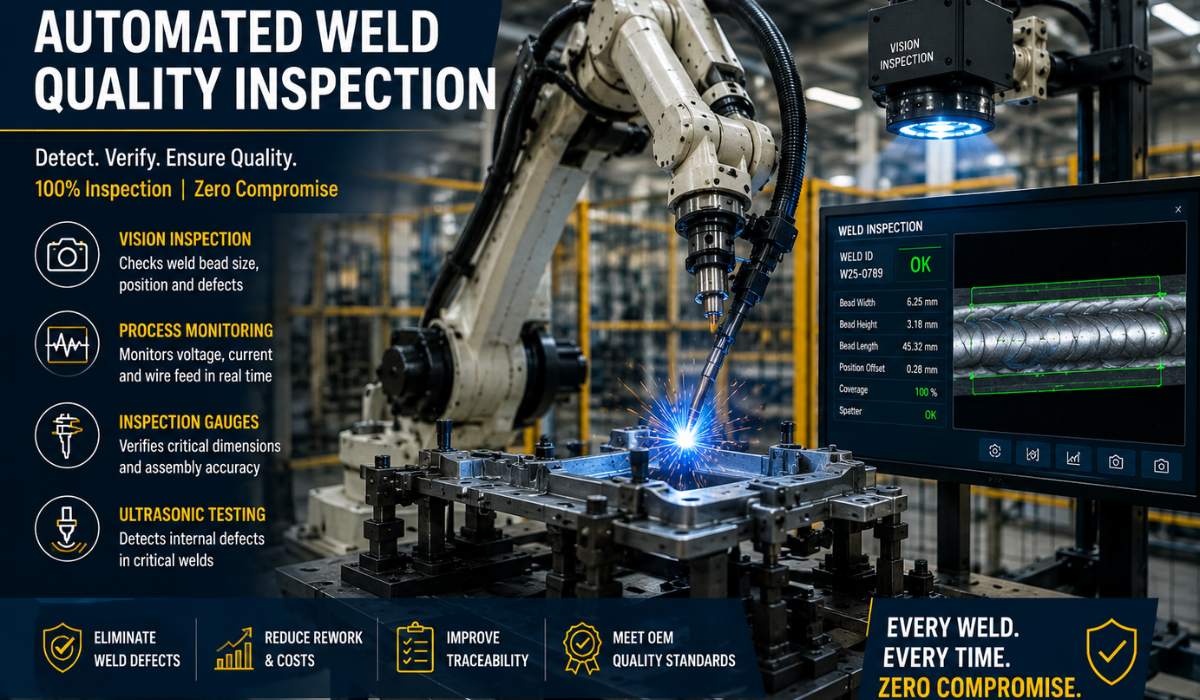
Camera systems — 2D vision for bead geometry and position, 3D structured light or laser profilometry for bead volume and surface profile — are now affordable and reliable for production environments. Mounted in a post-weld inspection station or integrated into the robot cell itself, they capture every weld immediately after deposition.
Vision systems check:
- Weld bead length, width, and height
- Position relative to the joint
- Presence or absence of weld at each programmed location
- Spatter distribution
They do not detect subsurface defects. For surface and dimensional defects — which account for the majority of OEM rejections — vision inspection is highly effective.
2. Inspection Gauges
Inspection gauges — both manual and automated — verify dimensional conformance of the welded assembly. For high-volume production, automated inspection gauges check every assembly in the same cycle time as production, with 100% coverage and documented results.
PARC Robotics designs and manufactures inspection gauges for automotive and industrial components. Our gauges handle profile verification, hole position checking, and critical dimension confirmation — integrated with data logging for traceability. Every assembly gets a pass/fail record linked to its serial number.
3. Weld Process Monitoring
Modern welding power sources log arc voltage, current, and wire feed rate for every weld. Process monitoring software analyzes this data in real time, flagging deviations from the programmed welding window. If a weld is made outside specification parameters — even if the physical weld is still acceptable — it’s flagged for review.
This is increasingly required by OEMs as part of traceability requirements. It costs nothing extra if your welding power source already has data logging capability — it just needs to be activated and integrated into your quality management system.
Robotic welding fixtures also play a major role in maintaining repeatable weld quality. Even minor fixture wear can affect weld position and assembly accuracy over time.
4. Ultrasonic Testing (UT) for Critical Applications
For safety-critical welds — suspension components, structural chassis members, pressure-containing assemblies — ultrasonic testing detects subsurface defects that vision systems cannot. Automated UT can be integrated into the production line for 100% inspection of critical weld joints. Capital cost is higher but eliminates the field failure risk that manual sampling cannot address.
Why 100% Weld Inspection Is Becoming Standard
Manufacturers across automotive, heavy engineering, and industrial fabrication sectors are moving toward complete weld verification rather than sampling.
Key reasons include:
- Increasing OEM quality requirements
- Growing demand for production traceability
- Higher cost of recalls and warranty claims
- Reduced tolerance for field failures
- Better availability of affordable vision systems
The shift is not just about quality. It is also about creating a digital quality record that can be audited, reviewed, and linked to every manufactured component.
Implementing Weld Inspection in an Existing Line
You don’t need to replace your welding system to add automated inspection.
The most practical sequence for Indian manufacturers:
Step 1: Activate Process Monitoring
Start with process monitoring — activate data logging on your existing welding power source.
Investment: Often minimal or zero.
Benefit: Immediate traceability.
Step 2: Add Inline Vision Inspection
Install a 2D camera with bead presence and position verification.
Budget: ₹3–8 Lakh depending on complexity.
Step 3: Install Automated Inspection Gauges
Add automated inspection gauges for critical assemblies.
Budget: ₹8–25 Lakh depending on fixture complexity and inspection requirements.
Step 4: Design Inspection into New Cells
For new installations, specify inspection requirements during the design phase rather than treating inspection as a future upgrade.
The Business Case for Weld Inspection Automation
The ROI calculation for inspection automation is often faster than for welding automation because the avoided cost is easier to measure.
OEM Return and Warranty Cost
A single batch rejection by a Tier-0 OEM — including logistics, sorting, rework, and corrective action documentation — can cost several lakhs of rupees.
One avoided rejection can justify the investment in an inspection station.
Internal Rework Reduction
Finding defects at the welding cell may require minutes of rework.
Finding them at final inspection may require hours.
Finding them at the OEM may require days of investigation, containment, and customer communication.
Audit Compliance
OEM and quality audits increasingly require documented in-process inspection and traceability.
Automated systems generate inspection records automatically and provide objective quality evidence.
Vision Inspection vs Other Inspection Methods
| Inspection Method | Surface Defects | Internal Defects | Relative Cost |
|---|---|---|---|
| Visual Inspection | Limited | No | Low |
| Vision Systems | High | No | Medium |
| Process Monitoring | Medium | No | Low |
| Ultrasonic Testing | High | Yes | High |
No single inspection method solves every quality problem. The most effective manufacturing systems combine process monitoring, dimensional verification, and targeted non-destructive testing where required.
PARC Robotics — Inspection Gauges and Automated Quality Systems
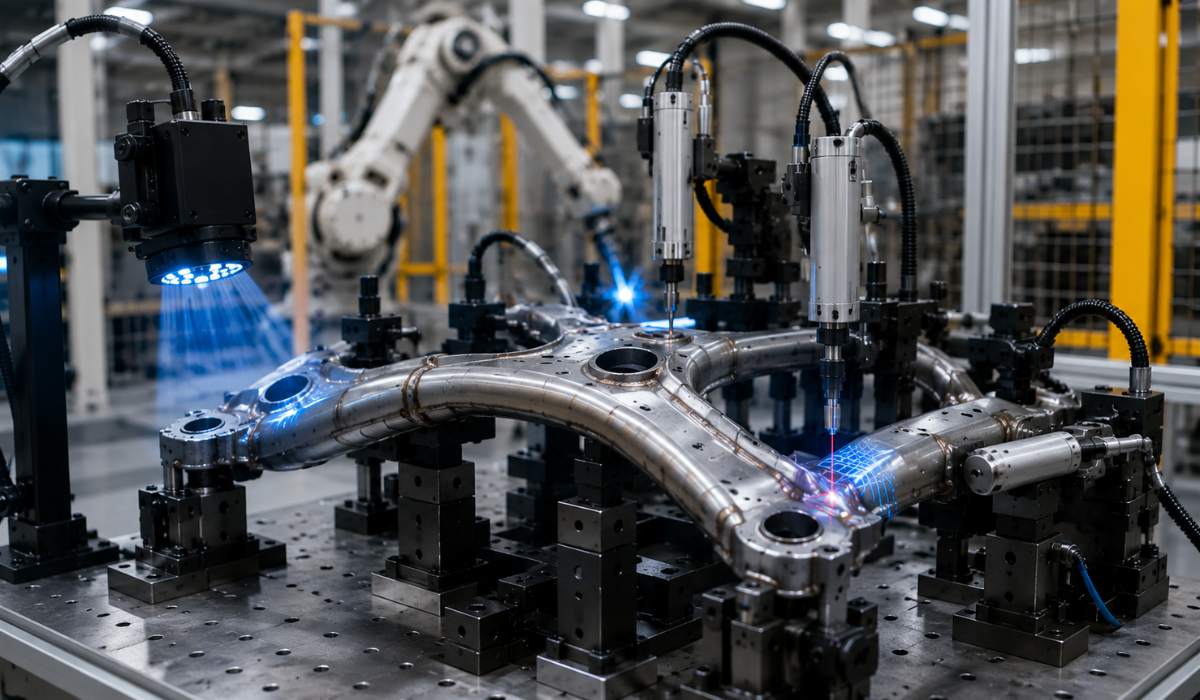
PARC Robotics designs and builds automated inspection gauges and weld quality verification systems for automotive and industrial manufacturers across India.
Our inspection solutions cover:
- Dimensional gauging
- Profile verification
- Weld quality validation
- Production traceability integration
- Automated reporting and quality records
Our inspection gauge projects are designed alongside welding systems — not added as afterthoughts. If you’re specifying a new welding cell, include inspection in the scope from the start.
To discuss weld inspection requirements for your production line, contact PARC Robotics at sales@parcrobotics.in or call +91 772 005 0057.
Conclusion
Robotic welding improves consistency, but consistency alone does not guarantee quality. The real challenge is verifying that every weld meets specification on every production cycle.
Automated weld quality inspection closes the gap between production and quality assurance by providing continuous verification, traceability, and documented inspection results.
For manufacturers supplying OEMs, reducing rework, improving compliance, and preventing field failures, inspection automation is becoming a production requirement rather than an optional upgrade.
Frequently Asked Questions
What is automated weld quality inspection?
Automated weld quality inspection uses cameras, sensors, inspection gauges, process monitoring software, and non-destructive testing methods to verify weld quality without relying solely on manual inspection.
Can automated weld inspection be added to an existing robotic welding cell?
Yes. Most manufacturers can start with process monitoring and vision inspection without replacing existing welding equipment.
What defects can vision-based weld inspection detect?
Vision systems can identify missing welds, weld position deviations, underfill, bead geometry issues, and surface spatter. They cannot detect subsurface defects.
Why is 100% weld inspection better than sampling?
Sampling checks only a small percentage of production. Automated inspection verifies every weld, reducing the risk of defective components reaching customers.
Do automated inspection gauges improve traceability?
Yes. Automated inspection gauges create digital inspection records that can be linked to individual parts, batches, or serial numbers for quality audits and traceability.
Author
Reviewed by the Engineering Team at PARC Robotics
PARC Robotics specializes in robotic welding systems, automated inspection gauges, welding fixtures, and industrial automation solutions for automotive and manufacturing companies across India. The team works on production automation projects focused on quality improvement, traceability, and operational efficiency.
Realted guides:
Material Handling Automation Solutions
Industry 4.0 Automation Solutions for Smart Manufacturing