
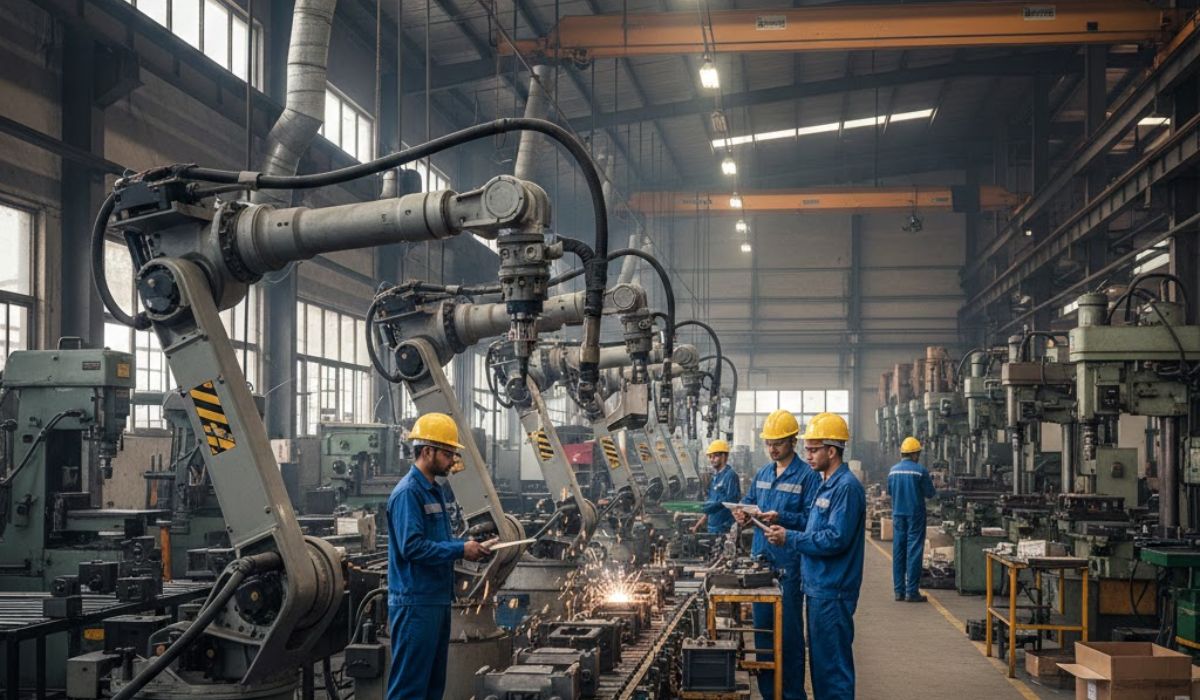
Indian manufacturing is standing at a critical turning point. For decades, growth depended on low-cost labor and incremental capacity expansion. That model is breaking down. Rising wages, inconsistent skill availability, tighter quality standards, and global competition are forcing Indian manufacturers to rethink how factories are designed and operated.
Robotics and automation are no longer “advanced options” reserved for large multinational plants. They are becoming core infrastructure for factories that want to survive and scale in the next decade.
This article breaks down the real future of robotics and automation in Indian manufacturing — without hype, without exaggeration, and without unrealistic promises.
Where Indian Manufacturing Stands Today
India’s robot adoption rate is still lower than most developed manufacturing economies. That’s not a weakness — it’s a window of opportunity.
Historically, robotics in India was limited to:
- Automotive OEMs and Tier-1 suppliers
- High-volume welding and paint shops
- Large export-driven manufacturing units
Most small and mid-sized factories relied heavily on manual processes. This worked when labor was cheap and quality demands were moderate. That era is ending.
Today, Indian manufacturers face:
- Difficulty hiring and retaining skilled operators
- Rising rejection and rework costs
- Pressure from global customers for consistent quality
- Delivery commitments that manual systems struggle to meet
Automation is now being evaluated not as a “nice-to-have” but as a structural necessity.
Why Future of Robotics Adoption Is Accelerating in India
Robotics adoption is not happening because technology is fashionable. It is happening because manual manufacturing is becoming unreliable.
1. Labor Is No Longer Predictable
Attrition rates in manufacturing are high. Skilled welders, machinists, and operators move frequently. Training new workers repeatedly kills productivity.
Robots don’t resign. They don’t forget procedures. They don’t lose consistency over long shifts.
2. Quality Expectations Are Non-Negotiable
Global buyers expect uniform output. Manual variation is no longer acceptable in industries like automotive, aerospace, EVs, and precision engineering.
Robots repeat the same motion with the same accuracy — every cycle.
3. Cost Pressure Over the Long Term
Manual setups look cheaper upfront. Over 3–5 years, labor costs, scrap, downtime, and quality failures add up.
Automation shifts cost from recurring expenses to a controlled capital investment.
4. Safety and Compliance
Hazardous processes like welding, handling heavy components, and repetitive operations expose factories to safety risks. Robots reduce accidents and compliance issues.
Key Robotics Technologies Transforming Indian Factories
Automation in India is not about installing robots blindly. Specific technologies are driving real value.
Industrial Robots: The Backbone of Automation
Industrial robots remain the most widely deployed automation technology in India. They are commonly used for:
- Welding
- Material handling
- Assembly
- Palletizing
- Machine loading and unloading
Their strength lies in repeatability and endurance. Once programmed and integrated correctly, they operate with predictable output for years.
Automotive suppliers still lead adoption, but general engineering and fabrication units are catching up fast.
Robotic Welding Automation: A High-ROI Use Case
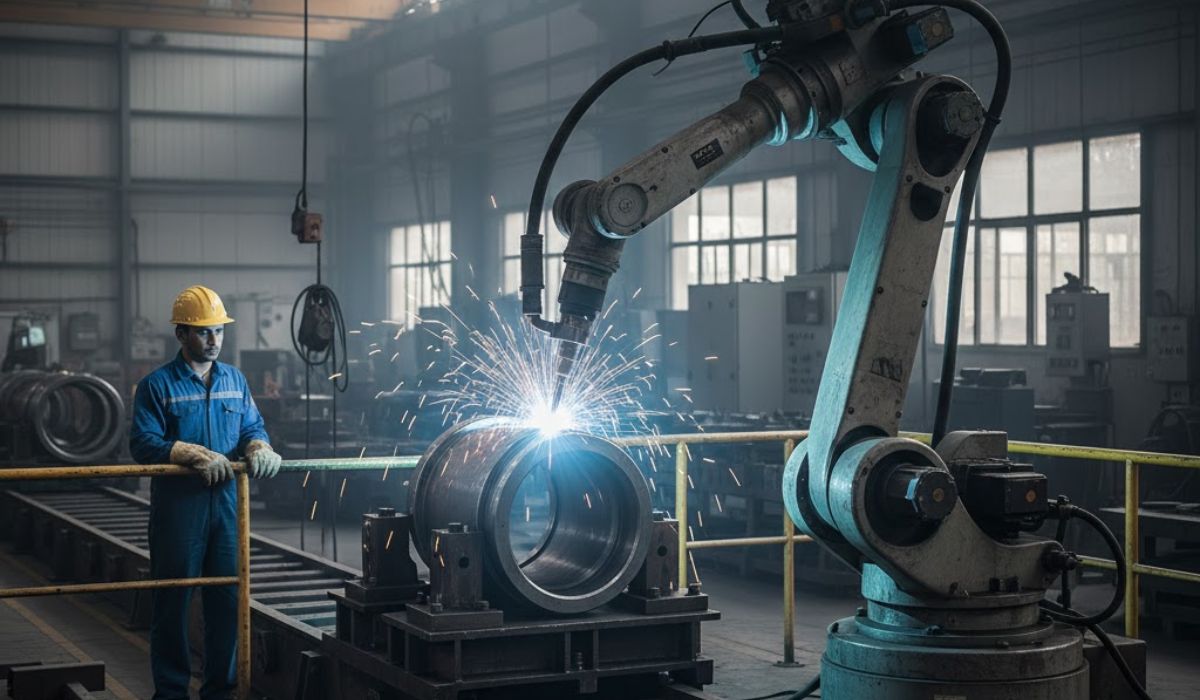
Welding is one of the clearest cases for automation in Indian manufacturing.
Manual welding suffers from:
- Inconsistent penetration
- Variable bead quality
- Operator fatigue
- High rejection rates
Robotic welding solves these issues by maintaining:
- Consistent travel speed
- Controlled arc parameters
- Repeatable torch positioning
For manufacturers dealing with medium to high volumes, robotic welding often delivers faster ROI than expected.
Special Purpose Machines (SPMs) and Custom Automation
Indian manufacturing is diverse. Many factories don’t fit standard automation templates.
This is where SPMs integrated with robotics play a crucial role. Custom automation allows manufacturers to:
- Solve process-specific challenges
- Combine multiple operations into one system
- Reduce manual handling and cycle time
Well-designed SPMs are not rigid. They are flexible systems built around real production constraints.
Collaborative Robots (Cobots): A Practical Entry Point for SMEs
Cobots are gaining traction among small and medium manufacturers.
Their advantages include:
- Smaller footprint
- Easier programming
- Lower safety infrastructure requirements
- Faster deployment
Cobots are not replacements for heavy industrial robots. They are complementary tools suited for:
- Light assembly
- Pick-and-place
- Inspection
- Machine tending
For SMEs hesitant about full-scale automation, cobots often act as the first step.
Machine Vision Systems: Enabling Smart Automation
Robots without vision are limited. Vision systems allow robots to:
- Identify part orientation
- Perform inspections
- Detect defects
- Align components dynamically
In Indian factories where input variation is common, vision-guided automation significantly improves reliability and flexibility.
Robotics and Industry 4.0: Beyond Mechanical Automation
The future of automation is not just about moving arms. It is about data-driven manufacturing.
Industry 4.0 integrates robotics with:
- Sensors and data collection
- Production monitoring dashboards
- Predictive maintenance systems
- ERP and MES platforms
This allows manufacturers to:
- Track downtime
- Optimize throughput
- Detect failures before breakdowns
- Make decisions based on real data
Smart factories are not science fiction anymore. They are being built in India today.
Robotics Adoption Among Indian SMEs: The Reality
A major myth persists: robotics is only for large factories.
In reality, SMEs stand to gain the most from automation when implemented correctly.
Real Benefits for SMEs
- Reduced dependency on skilled labor
- Predictable output
- Lower rejection and rework
- Ability to scale without proportional manpower increase
The Real Risk
Automation fails when SMEs:
- Buy machines without process analysis
- Ignore fixturing and safety design
- Underestimate integration complexity
The success of robotics depends more on system design than robot brand.
Industries Driving the Next Phase of Automation
Not all sectors will adopt robotics at the same pace.
Automotive and EV Manufacturing
EV production demands precision, repeatability, and high safety standards. Robotics adoption here will accelerate sharply.
Aerospace and Defense
Low-volume, high-accuracy manufacturing requires advanced automation and traceability.
Heavy Engineering and Fabrication
Robotic handling and welding improve both productivity and worker safety.
Electronics and Medical Devices
Precision, cleanliness, and consistency make automation unavoidable.
Challenges Slowing Robotics Adoption in India
Ignoring challenges leads to failed projects. Let’s be clear about the real barriers.
High Initial Capital Perception
Many manufacturers still evaluate automation with short-term thinking instead of lifecycle ROI.
Skill Gaps in Automation Engineering
Poor programming, weak integration, and inadequate maintenance planning reduce system effectiveness.
Resistance to Change on Shop Floors
Automation requires cultural change. Without worker involvement and training, adoption becomes difficult.
Poor Vendor Selection
Choosing automation partners based only on price often results in underperforming systems.
What the Future Realistically Looks Like
The future of robotics in India is not fully automated, human-free factories.
What will actually happen:
- More hybrid human-robot workcells
- Wider use of cobots in SMEs
- Smarter integration with data systems
- Focus on flexible automation instead of rigid lines
Factories will not replace people entirely. They will use robots to remove inefficiency, inconsistency, and risk.
Long-Term Impact on Indian Manufacturing Competitiveness
Manufacturers who adopt robotics thoughtfully will gain:
- Better quality consistency
- Higher throughput
- Stronger export competitiveness
- Greater resilience to labor volatility
Those who delay adoption will struggle with cost pressure, quality failures, and delivery issues.
Automation is becoming a baseline capability, not a competitive advantage.
Final Perspective
Robotics and automation are no longer future concepts for Indian manufacturing. They are present-day tools solving real operational problems.
The real divide will not be between automated and non-automated factories.
It will be between factories that planned automation intelligently and those that rushed or ignored it.
The future belongs to manufacturers who treat automation as a long-term strategy, not a quick fix.
People Also Ask
1. What is the role of robotics in Indian manufacturing?
Robotics helps Indian manufacturers improve productivity, maintain consistent quality, reduce dependence on manual labor, and meet global production standards.
2. Why is automation becoming important for Indian factories?
Automation is becoming important due to rising labor costs, skill shortages, increasing quality expectations from global buyers, and the need for predictable output.
3. Which industries in India will lead the future of robotics adoption?
Automotive, EV manufacturing, aerospace, heavy engineering, electronics, and medical device industries are expected to lead the future of robotics adoption in India due to their need for precision, safety, and scalable production.
4. Is robotics suitable for small and medium manufacturing companies in India?
Yes. Many small and medium manufacturers use robotics and collaborative robots to improve efficiency, reduce rework, and scale production without increasing manpower.
5. What types of robots are commonly used in Indian manufacturing?
Industrial robots for welding and material handling, collaborative robots for assembly and machine tending, and vision-guided robots for inspection are commonly used in Indian manufacturing.
6. What challenges do Indian manufacturers face when adopting robotics?
Common challenges include high initial investment perception, lack of automation expertise, resistance to change on the shop floor, and poor system integration planning.
7. How will robotics impact the future of Indian manufacturing?
Robotics will enable more efficient, safer, and data-driven factories, helping Indian manufacturers remain competitive in global and domestic supply chains.