
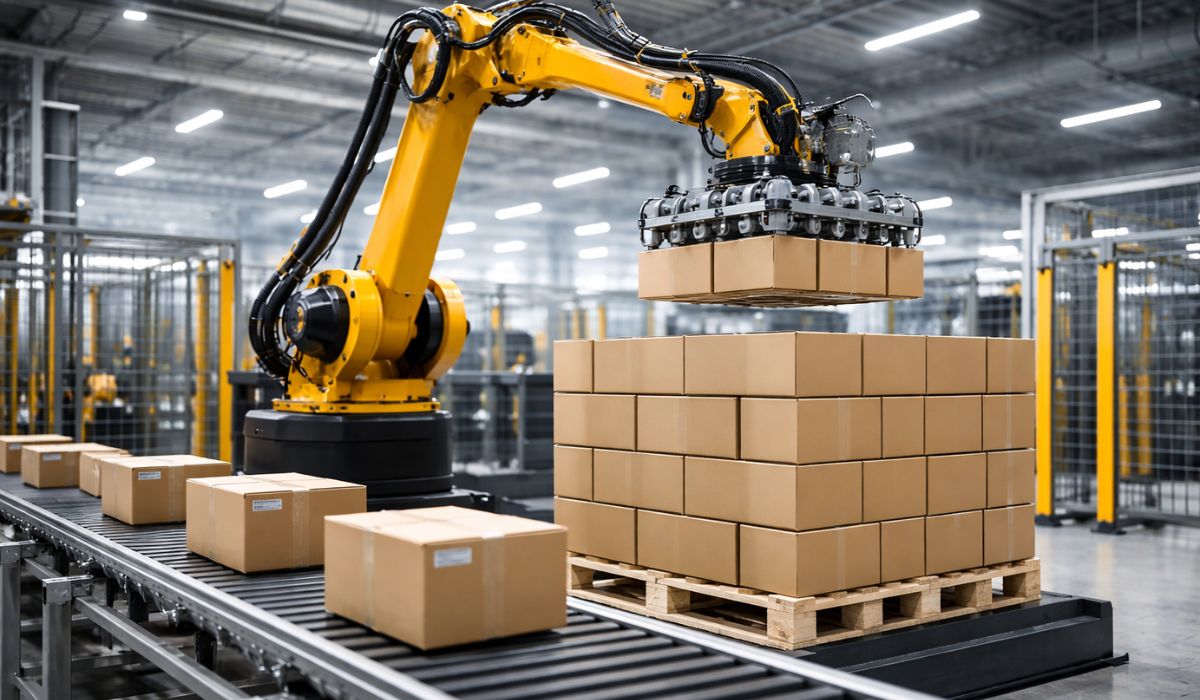
For industrial manufacturers, the final step of production—palletizing—is often the most physically demanding and logistically critical. Every day, workers manually stack thousands of cases, bags, or products onto pallets, relying on endurance and consistency to meet shipping deadlines.
Labor shortages, safety risks, and the need for faster throughput are forcing manufacturers to rethink this approach.
Robotic palletizing solutions have emerged as the industry standard for automating this bottleneck. By integrating industrial robots with smart material handling systems, manufacturers can achieve consistent, high‑speed palletizing while freeing workers from repetitive lifting.
Unlike conventional fixed‑axis palletizers, a robotic palletizing system offers the flexibility to handle multiple product sizes, packaging types, and stacking patterns on a single line.
This guide focuses specifically on robotic palletizing—its components, types, benefits, and the industries that rely on it. For decision‑makers in manufacturing and logistics, understanding these solutions is the first step toward building a safer, more efficient, and scalable end‑of‑line operation.
What Are Robotic Palletizing Solutions
Robotic palletizing solutions use programmable industrial robots to automatically stack cases, bags, pails, or other unit loads onto pallets.
The robot is equipped with an end‑of‑arm tool (EOAT)—such as a vacuum head, mechanical gripper, or clamp—that picks individual products from an infeed conveyor and places them onto a pallet according to a pre‑defined pattern.
The core advantage of a robotic palletizer is flexibility. While conventional palletizers are built for a single product and pattern, a robotic palletizer can handle dozens of SKUs.
It can switch between different case sizes, bag types, or pallet patterns with a simple program change. This makes it ideal for mixed‑product lines and high‑mix manufacturing environments.
Automated palletizing systems are typically built around articulated arm robots (6‑axis), though delta or collaborative robots are used in specific applications. They integrate with pallet dispensers, stretch wrappers, and warehouse management systems to form a complete industrial palletizing automation cell.
Why Industries Are Adopting Robotic Palletizing
Manufacturers across sectors are moving to robotic palletizing because manual palletizing creates operational weaknesses that are no longer acceptable in a competitive market.
Labor shortages and high turnover
Palletizing is physically strenuous. Even with rotation, workers experience fatigue, leading to inconsistent stacking and increased injury risk. Finding and retaining workers willing to perform this role is increasingly difficult.
A palletizing robot operates without breaks, delivering predictable throughput every shift.
Safety and ergonomics
Musculoskeletal injuries from repetitive lifting and twisting are among the most common in manufacturing. By removing workers from the palletizing zone, companies significantly reduce recordable incidents and workers’ compensation costs.
Throughput and reliability
Manual palletizing rates vary by operator and often decline toward the end of a shift. Robotic palletizing solutions run at consistent speeds—often 30 to 60 cases per minute or more—and can operate 24/7.
This ensures that upstream production lines are not slowed by downstream bottlenecks.
Flexibility in production
The trend toward smaller batch sizes and more SKUs means that a dedicated conventional palletizer for each product is no longer feasible. A single automated palletizing system can service multiple lines, handling different case sizes and patterns with minimal changeover time.
Key Components of a Robotic Palletizing System
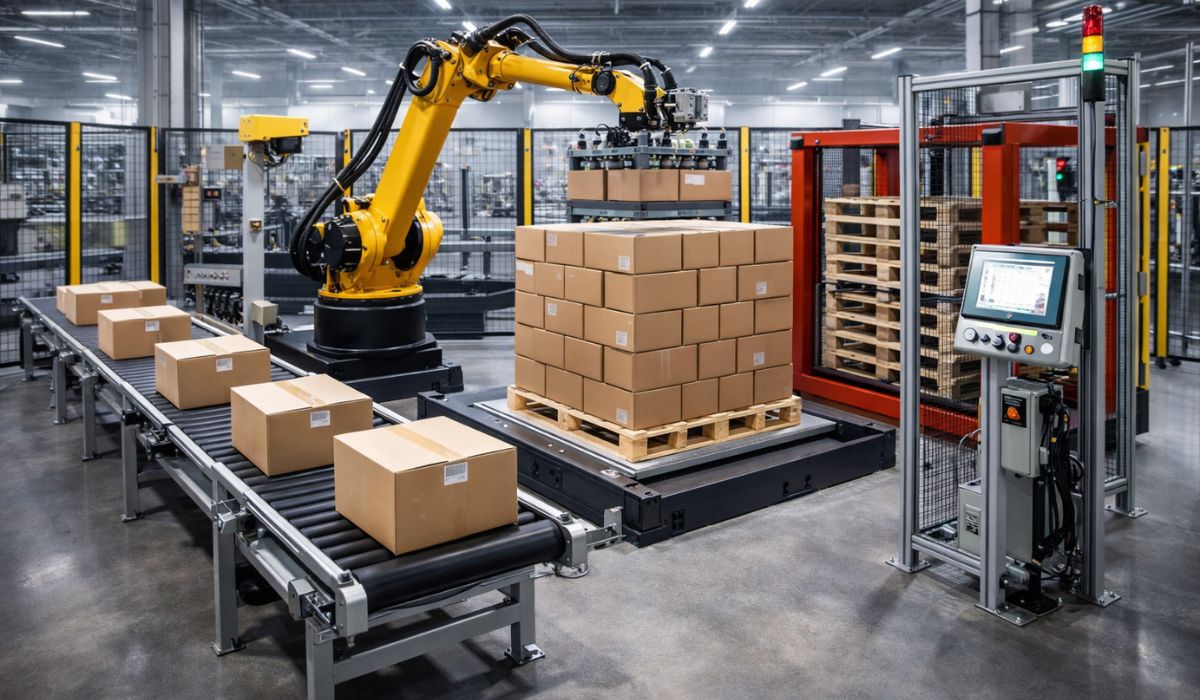
A complete robotic palletizing system is more than just the robot arm. It includes several integrated components that work together to ensure reliable, safe operation.
Robot arm
The core of the robotic palletizer is an articulated industrial robot, typically with 4 to 6 axes of motion. The robot’s reach and payload capacity are selected based on the product weight, pallet size, and layout of the cell.
End‑of‑arm tooling (EOAT)
The gripper is tailored to the product. Within a palletizing robot, vacuum heads are common for handling cardboard cases; mechanical grippers or clamps are used for bags, pails, or irregular shapes.
For delicate products, foam‑lined grippers or servo‑controlled jaws prevent damage.
Pallet dispenser
Empty pallets are automatically fed into the palletizing station from a magazine. This eliminates manual pallet handling and ensures continuous operation. Some systems include pallet stackers for handling multiple pallet sizes.
Infeed conveyor and product orientation
Products arrive on a conveyor. Vision systems or sensors detect the orientation and position of each case, allowing the robot to pick accurately.
For mixed‑line operations, a scanning system identifies the SKU and selects the appropriate stacking pattern.
Safety fencing and guarding
Robotic cells are enclosed with physical barriers, light curtains, or area scanners to protect operators while allowing maintenance access. Interlocked doors ensure that the robot stops if a person enters during operation.
Programmable logic controller (PLC) and HMI
A central control system coordinates the robot, conveyor, dispenser, and any downstream equipment like stretch wrappers. The human‑machine interface (HMI) provides operators with status updates, fault diagnostics, and recipe management for different products.
Types of Robotic Palletizing Systems
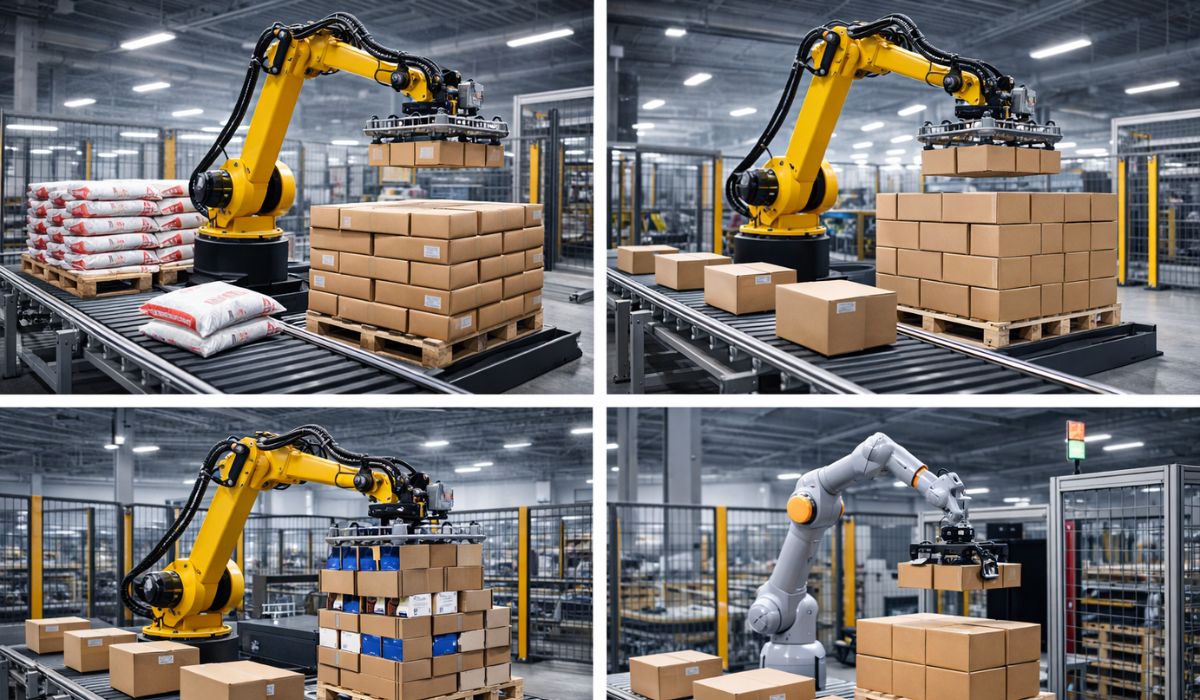
Not all robotic palletizing solutions are the same. The choice of system depends on product type, throughput requirements, and facility layout.
Case palletizing
The most common application, where the robot stacks uniform or mixed cardboard cases onto pallets. Used extensively in food, beverage, and consumer goods industries.
Bag palletizing
Handling flexible bags (e.g., cement, pet food, chemicals) requires specialized grippers and pattern programming to account for bag settling and interlocking. Robotic palletizing solutions for bags maintain consistent patterns that manual stacking often fails to achieve.
Mixed‑SKU palletizing
In e‑commerce and distribution centers, the robot builds pallets containing multiple product types. These automated palletizing systems often use 3D vision to identify each item and calculate an optimized stacking pattern.
This is one of the fastest‑growing segments of industrial palletizing automation.
High‑speed palletizing
For very high throughput, manufacturers may use a palletizing robot with dual infeed lanes or a “layered” approach. The robot builds a full layer on a staging table before transferring it to the pallet. Speeds can exceed 100 cases per minute.
Collaborative palletizing
Using collaborative robots (cobots) allows the system to operate without full fencing in low‑speed applications. Cobots are often deployed in facilities with frequent changeovers or where space is limited.
Industries Using Robotic Palletizing
Robotic palletizing solutions are now found across virtually every manufacturing and logistics sector. The most common adopters include:
Food and beverage
High‑speed lines, washdown requirements, and a wide variety of packaging (cans, bottles, pouches, trays) make this a primary market. Palletizing robots are often rated for high‑pressure washdown environments to meet sanitation standards.
Pharmaceuticals and medical devices
Accuracy and traceability are critical. Automated palletizing systems integrate with serialization to ensure that every case and pallet is correctly identified and tracked, supporting regulatory compliance.
Consumer packaged goods (CPG)
With hundreds of SKUs, CPG manufacturers rely on industrial palletizing automation for flexibility. Changeovers that once took an hour can be completed in minutes through recipe‑based controls.
Automotive and heavy equipment
Robotic palletizing solutions handle heavy parts, engines, and assemblies, often stacking them into returnable metal racks or custom pallets. The robots are sized for high payloads and harsh factory environments.
Building materials and chemicals
Bag palletizing for cement, fertilizer, and chemicals is a classic robotic application. Palletizing robots handle dust‑prone environments and maintain consistent patterns that improve load stability during transit.
Warehousing and third‑party logistics
Distribution centers use automated palletizing systems to build mixed‑SKU pallets for retail replenishment. Vision‑guided robots can handle items arriving in random order, drastically reducing manual labor.
Benefits of Robotic Palletizing
The decision to invest in robotic palletizing solutions is driven by clear, measurable returns that go beyond simply replacing manual labor.
Higher throughput
A palletizing robot operates at consistent speed, without breaks or shift changes. This eliminates the palletizing bottleneck, allowing upstream packaging machines to run at full capacity.
Reduced labor costs and turnover
By automating the most physically demanding role, manufacturers reduce their dependency on a hard‑to‑find workforce. Existing employees can be upskilled to supervise and maintain automated systems.
Improved workplace safety
Eliminating manual palletizing removes the risk of back injuries, strains, and forklift‑pedestrian collisions. Safety records improve, and workers appreciate being moved to higher‑value tasks.
Floor space efficiency
Robotic palletizing solutions have a smaller footprint than conventional palletizers or manual staging areas. A single robot cell can often replace multiple manual stations, freeing up factory space.
Product consistency and load stability
Robots stack every case in exactly the same position, following an optimized pattern. This reduces product damage during transport and eliminates customer complaints about unstable or poorly stacked pallets.
Scalability and flexibility
As production volumes or product lines change, automated palletizing systems can be reprogrammed or expanded. New recipes are added via software, not mechanical rework, making the system future‑ready.
Challenges in Traditional Palletizing
To fully appreciate the value of robotic palletizing, it helps to understand the limitations of traditional manual or conventional automated approaches.
Manual palletizing
Manual palletizing is labor‑intensive and inherently inconsistent. Stack quality depends on the individual operator; fatigue leads to poor patterns, overhangs, and collapsed loads. Turnover rates are high, and training new operators takes time away from production.
Conventional (fixed‑axis) palletizers
While faster than manual, conventional palletizers are dedicated to a single product size and pattern. Changing over can take hours and often requires mechanical adjustments. They also occupy a large footprint and cannot easily handle mixed SKUs.
Safety and ergonomic risks
Even with ergonomic assists, manual palletizing exposes workers to cumulative trauma. The constant presence of forklifts moving empty and full pallets creates congestion and accident risk.
Inefficient floor space
Manual stations require space for staging empty pallets, storing finished loads, and allowing operators to move around. This space could often be better used for production or storage.
How to Choose a Robotic Palletizing System
Selecting the right robotic palletizing solution requires evaluating several technical and operational factors. A poorly matched system can create bottlenecks or require costly modifications later.
Payload and reach
Determine the maximum weight of the cases or products being stacked. The palletizing robot must have sufficient payload capacity at full reach to handle the heaviest items and the tallest pallet height.
Product type and packaging
The physical characteristics of your products—case rigidity, surface texture, bag flexibility—dictate the EOAT design. For mixed SKUs, a robotic palletizer with quick‑change tooling or vacuum‑based grippers may be required.
Throughput requirements
Calculate the number of cases per minute that must be palletized. High‑speed applications may need a dedicated automated palletizing system with dual infeed lanes or a layered palletizing architecture.
Floor space and layout
Assess available floor space. Robotic palletizing cells are generally compact, but you must account for safety zones, pallet dispenser positions, and conveyor integration. Some facilities benefit from ceiling‑mounted or gantry robots to maximize floor space.
Integration with existing lines
The system must interface with upstream conveyors, downstream stretch wrappers, and facility‑wide controls. Choose industrial palletizing automation that uses common communication protocols (Ethernet/IP, Profinet) and can integrate with your existing PLC environment.
Future flexibility
If your product mix is expected to expand, prioritize a robotic palletizer with recipe‑based controls and easy changeover. Systems with digital twin simulation and offline programming will simplify future updates.
The Future of Robotic Palletizing
Industrial palletizing automation is evolving rapidly as new technologies converge. For manufacturers planning long‑term automation strategies, these trends are worth watching.
AI‑driven pattern optimization
Artificial intelligence is enabling robotic palletizing solutions to calculate the most stable stacking pattern in real time, even with mixed‑size cases. This reduces the need for pre‑programmed recipes and allows the system to adapt to unexpected product variations.
3D vision and vision‑guided robotics
Advanced vision systems allow robots to pick randomly placed items from a conveyor or even from a pallet. This is critical for depalletizing and for handling unoriented products in mixed‑SKU palletizing.
Digital twins and offline programming
New palletizing recipes can be simulated in a digital twin environment before being deployed on the physical robot. This minimizes downtime during changeovers and allows engineers to optimize cycle times without interrupting production.
Autonomous mobile robots (AMRs)
AMRs are increasingly used to deliver empty pallets to the palletizing robot and transport finished loads to the stretch wrapper or warehouse. This eliminates forklift traffic in the palletizing area and creates a fully autonomous material flow.
Sustainability considerations
Automated palletizing systems enable the use of lighter, more sustainable packaging that is too flimsy for manual handling. They also reduce cardboard waste by optimizing layer patterns and can apply stretch film with precision to minimize plastic use.
Conclusion
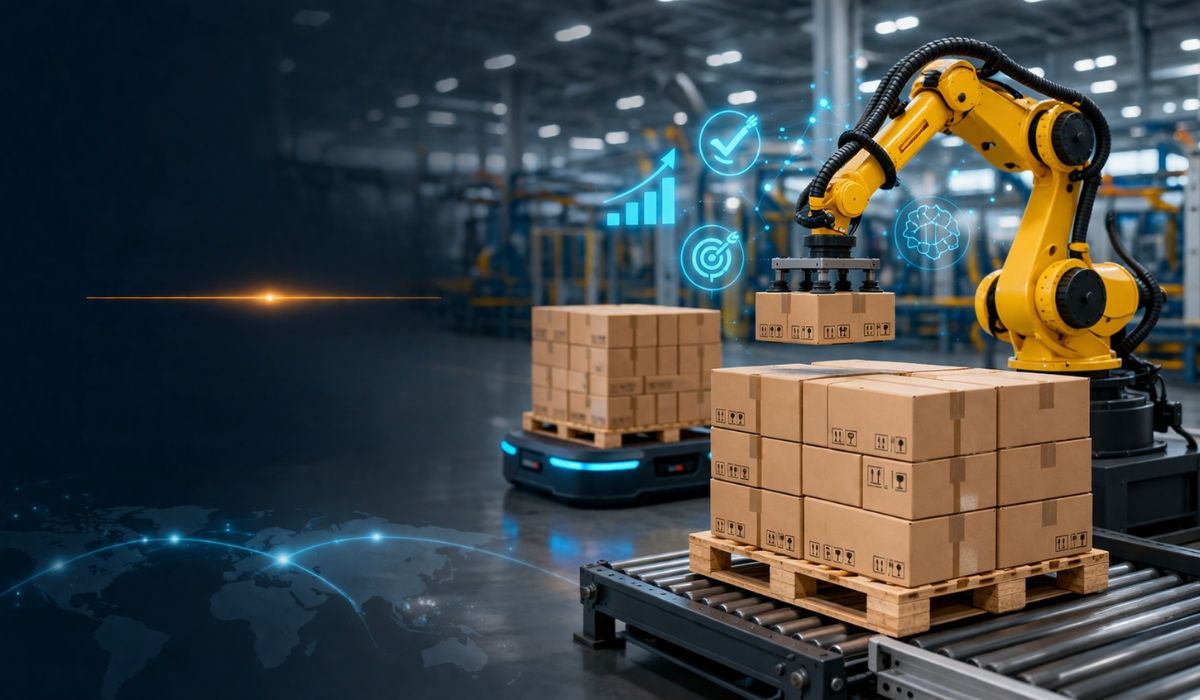
For industrial manufacturers and automation decision‑makers, robotic palletizing solutions represent one of the highest‑impact automation investments available.
The benefits extend far beyond labor reduction: they include safer workplaces, consistent product quality, higher throughput, and the flexibility to adapt to changing market demands.
Traditional manual palletizing and conventional fixed‑axis systems are increasingly unable to meet the demands of modern production—especially in environments with high SKU counts, labor shortages, and tight shipping windows.
Robotic palletizing closes that gap, providing a scalable, future‑ready solution that integrates seamlessly with upstream packaging equipment and downstream warehouse systems.
Manufacturers planning to implement robotic palletizing solutions should evaluate system flexibility, integration capability, and long‑term scalability before selecting an automation partner. The right solution will not only solve today’s palletizing bottleneck but also provide a platform for continuous improvement and growth.
Related topics: robotic welding systems, material handling automation, assembly line automation, end-of-line automation.