
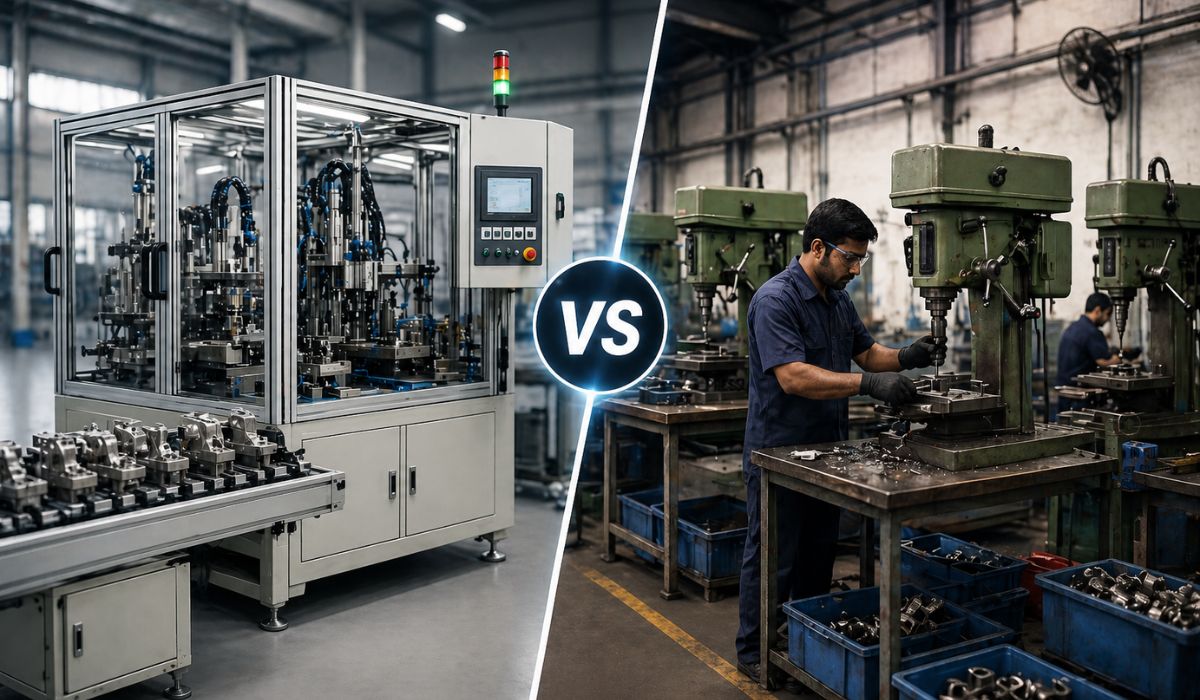
SPM vs Standard Machine — Quick Decision Guide
If you’re confused between a Special Purpose Machine (SPM) and a standard machine, use this quick rule:
- Choose SPM when your production is high, repetitive, and requires strict cycle time
- Choose standard machines when flexibility and low investment matter more
Quick Comparison
| Factor | SPM | Standard Machine |
|---|---|---|
| Use Case | Mass production | Job work / mixed production |
| Speed | High | Moderate |
| Flexibility | Low | High |
| Cost | High upfront | Lower upfront |
| Output Consistency | Very high | Depends on operator |
This is the question every Indian plant manager faces at some point in their expansion: do I buy a standard machine, or invest in a Special Purpose Machine built for my exact process? The answer depends on your production reality — not on what the machine builder recommends.
What Is a Special Purpose Machine?
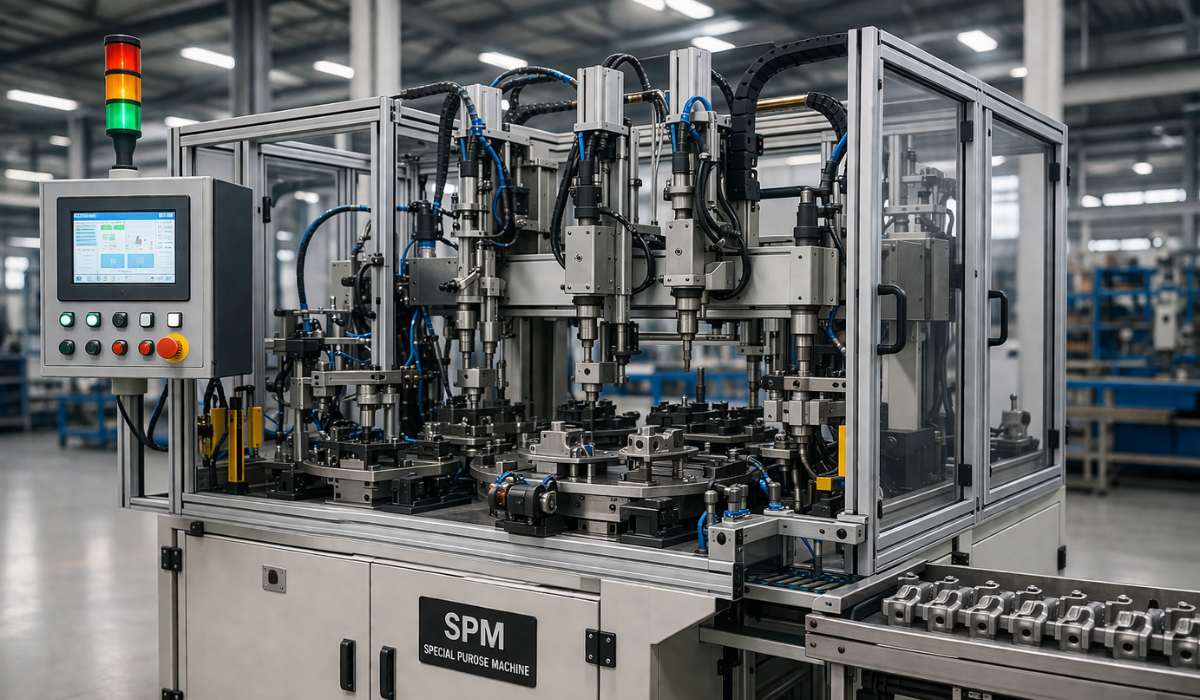
A Special Purpose Machine — commonly called an SPM — is a machine designed and built for one specific manufacturing task or a defined set of tasks on a specific component. It is not available off the shelf. It is engineered from scratch based on your part geometry, process requirements, cycle time, and quality standards.
A standard machine, on the other hand, is a general-purpose piece of equipment — a lathe, a drill press, a MIG welding machine, a press brake — that can handle a range of tasks across different parts. It is readily available, competitively priced, and widely supported.
The choice between them is not about which technology is better. It is about which approach delivers the right output for your specific volume, quality, and cost situation.
Why This Decision Matters in Manufacturing
Choosing the wrong machine is not just a technical mistake—it’s a cost problem.
- Over-invest → capital stuck, low ROI
- Under-invest → higher per-unit cost, slower production
- Wrong setup → quality inconsistency and rework
In most Indian manufacturing setups, this decision directly impacts profitability within the first 6–12 months.
The Core Problem SPMs Solve
Standard machines are designed for flexibility. That flexibility comes at a cost — they require setup time per job, operator skill to achieve consistent results, and multiple handling steps when a part needs sequential operations.
In high-volume production, these inefficiencies compound. Consider a component that requires drilling 8 holes in a specific pattern, then pressing in 2 bearing inserts, all within a 45-second takt time. A standard machine setup requires 3 to 4 separate operations, each with its own setup and handling. An SPM does all of this in a single cycle, at the required takt time, with 100% repeatability.
That is the core value proposition: SPMs eliminate the gap between what your process requires and what standard equipment can deliver.
Types of SPMs Used in Indian Manufacturing
Before getting into the decision framework, it helps to understand the range of SPMs available. The table below covers the most common types used in Indian automotive, aerospace, and industrial manufacturing:
|
SPM Type |
What It Does | Indian Application Example | Typical Cycle (sec) |
|---|---|---|---|
|
Welding SPM |
MIG/TIG/Spot welding on specific components |
Fuel tank seam welding, bracket welding |
2000–4000 |
|
Drilling & Boring SPM |
Multi-spindle precision drilling in single cycle |
Engine block bore, flange drilling |
800–2000 |
|
Press & Riveting SPM |
Controlled force pressing and riveting |
Hinge riveting, bearing press-fit |
400–1200 |
|
Assembly SPM |
Multi-station sub-assembly with pneumatic actuation |
Brake assembly, switch assembly |
600–2000 |
|
Inspection / Gauging SPM |
100% in-line dimension and profile verification |
Body panel profile check, hole position gauge |
500–1500 |
|
Hydraulic Fixture SPM |
Hydraulic clamping with machining or welding |
CNC fixture for engine components |
300–1200 |
How to Identify If You Actually Need an SPM
Before considering an SPM, check these signals:
- Same component produced repeatedly
- Monthly volume consistently above 400–500 units
- Process steps are fixed (drilling, welding, pressing)
- Cycle time is becoming a bottleneck
- Quality variation is increasing with operators
If most of these apply, standard machines are already limiting your growth.
SPM vs Standard Machine — The Decision Framework
Use the table below as your first filter. For each parameter in your production situation, identify which column applies. If most of your answers fall in the SPM column, the investment is likely justified:
|
Parameter |
Choose SPM | Keep Standard | Hybrid / Phased |
|---|---|---|---|
|
Part Design |
Fixed — production part with stable drawing |
Variable — design changes frequently | Finalized prototype moving to production |
|
Volume / Month |
500+ identical parts per month |
Less than 100 units per run |
100–500 units, growing |
|
Process |
Defined, repeatable — drilling, pressing, welding, gauging |
Multi-step, variable, assembly-intensive |
Core process defined, peripherals variable |
|
Cycle Time Need |
Strict — OEM line takt time must be met |
Flexible — no takt time constraint |
Moderate — improving over time |
|
Quality Requirement |
Zero-defect — aerospace, automotive, medical |
Acceptable variation tolerated |
OEM-grade needed within 6–12 months |
| Budget |
INR 15 Lakh to 1.5 Crore — ROI justified by volume |
Limited — below INR 10 Lakh |
INR 10–40 Lakh — phased investment possible |
| Floor Space | Dedicated cell possible | Shared, flexible floor space |
Can dedicate 1 station |
Common Mistake Manufacturers Make
Many manufacturers delay SPM investment too long.
They continue using standard machines even when:
- Production volume has increased
- Rejection rates are rising
- Operators are overloaded
Result:
- Hidden costs increase
- Efficiency drops
- Scaling becomes difficult
By the time they switch, they’ve already lost months of productivity.
The Real Cost of Using Standard Machines for High-Volume Work
When manufacturers use standard machines for work that genuinely warrants an SPM, the costs are real — they are just distributed across the P&L in ways that are rarely traced back to the machine choice.
Operator dependency — Standard machine output quality is directly tied to the operator’s skill, attention, and fatigue level. Shift changes create quality variance.
Multi-step handling — Moving parts between multiple standard machines adds cycle time, increases handling damage risk, and introduces intermediate WIP buildup on the floor.
Cycle time ceiling — Standard machines have a physical throughput limit. When volume increases, the only options are overtime, additional machines, or — eventually — an SPM.
Audit and traceability risk — OEM audits increasingly require documented in-process quality checks. Standard machines typically cannot provide this without additional instrumentation.
The compounding effect — Each of these costs individually seems manageable. Together, across a production run of 1,000 assemblies per month, they typically add 8–15% to per-unit manufacturing cost compared to a well-designed SPM.
Hidden Costs You Don’t See Immediately
Apart from visible costs, standard machines create hidden losses:
- Idle time between operations
- Material handling delays
- Operator fatigue errors
- Quality inconsistency across shifts
These don’t show in one report—but they reduce margins over time.
When Standard Machines Are the Right Answer
SPMs are not the answer to every production problem. Standard machines win clearly in the following situations:
- Production volumes below 200 units per month of a given part — SPM design and build cost cannot be amortized
- Frequent part design changes — an SPM designed for today’s drawing may be obsolete in 6 months if the part changes significantly
- High-mix, low-volume production environments where flexibility across many part types is the primary requirement
- Early-stage products still in design iteration — invest in SPM only after the design is frozen and production volumes are confirmed
- Tight cash flow with no capital expenditure headroom — a well-maintained standard machine running at 85% efficiency beats a poorly maintained SPM
SPM Is Not a Shortcut — It’s a Commitment
An SPM is not just a machine—it’s a production strategy.
Once implemented:
- Your process becomes fixed
- Flexibility reduces
- Efficiency increases
That’s why the decision must be based on long-term production planning, not short-term pressure.
The 5 Questions to Ask Before Commissioning an SPM
Before engaging any SPM manufacturer, get clear answers to these questions internally:
- Is the part drawing frozen? — SPMs are designed around a specific drawing revision. A significant engineering change post-build can require expensive rework or render the machine obsolete.
- What is the confirmed monthly volume for the next 24 months? — SPM ROI calculations must be based on realistic, conservative volume projections. Optimistic volume numbers are the most common reason SPM investments underperform.
- What is the required cycle time? — Derive this from your line takt time or your OEM’s delivery schedule. This drives the entire machine design.
- What is the quality acceptance standard? — Define dimensional tolerances, surface finish requirements, and any in-process measurement needs before design starts, not after.
- Who will maintain the machine? — SPMs require in-house maintenance competence. If your maintenance team has no prior SPM experience, build training and ongoing support into the contract.
What a Good SPM Manufacturer Should Provide
Not all SPM manufacturers operate at the same level of engineering rigour. When evaluating manufacturers, look for:
- Detailed design review with simulation before fabrication begins — a manufacturer who jumps directly from requirement to build without a formal design review stage is a risk
- Fixture and tooling design capability in-house — outsourced fixture design creates accountability gaps
- On-site commissioning and first article inspection at your plant, not just at their facility
- Documented cycle time validation — the manufacturer should demonstrate the required cycle time under production conditions, not demonstration conditions
- A clear warranty and breakdown response commitment — SPM downtime stops your production line
- References from clients in your industry with similar complexity requirements
PARC Robotics’ Approach to SPM Design
At PARC Robotics, we have been designing and building Special Purpose Machines for automotive and industrial clients since 2016. Our facility in Chakan, Pune handles the complete SPM lifecycle — requirement analysis, mechanical and electrical design, fabrication, assembly, controls programming, and commissioning.
Our SPM portfolio covers welding SPMs, hydraulic fixture-based machining systems, press and riveting systems, assembly SPMs, and automated inspection gauges. Each machine is designed around the client’s specific component, process, and production requirements — not around a standard platform.
We work with Tier-1 automotive suppliers, OEMs, and industrial manufacturers across India. Our clients include companies supplying to Tata, Toyota, Hyundai, MG, JCB, and Maruti.
If you are evaluating an SPM for your production line, the right starting point is a process and volume review — not a quote. Contact our engineering team to discuss your requirement.
PARC Robotics — Special Purpose Machines, Robotic Systems, Manual Systems. Chakan, Pune, Maharashtra. Contact: sales@parcrobotics.in | +91 772 005 0057
Final Thought Before You Decide
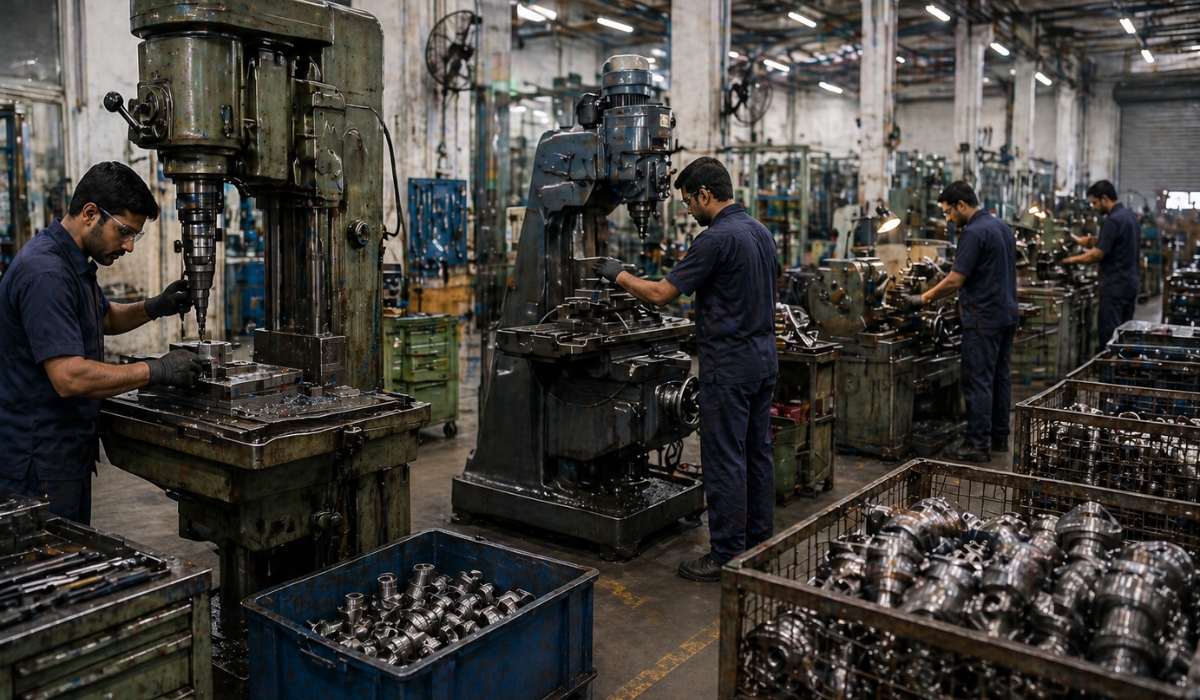
If your production is scaling but your process still depends on multiple standard machines, your cost per unit is already higher than it should be.
Most manufacturers don’t realize this until:
- They lose orders
- Or fail OEM audits
- Or face consistent quality issues
A machine decision is not about equipment—it’s about how efficiently your entire production system runs.