
The Problem Isn’t Technology – It’s Consistency
Monday morning. First shift. Weld quality passes.
By Wednesday, rejection creeps from 3% to 8%. By Friday, the rework bench is full. The supervisor is chasing welders. The night shift lead quit two weeks ago. His replacement is still guessing parameters.
You are not losing money because your welders lack skill. You are losing money because manual welding is operationally unstable.
Across Pune, Chennai, and Gurugram, skilled MIG welders now command ₹35,000–₹50,000 per month. Attrition in fabrication shops commonly runs 20–30% annually – a number we see repeatedly in shop floor interviews.
The question is no longer if welding automation makes sense. The question is: what does a robotic welding system cost in India, and when does the math actually work?
This is not a vendor pitch. It is an engineering and economic framework from 40+ Indian factory floor integrations.
Component-by-Component Cost Breakdown (2026)
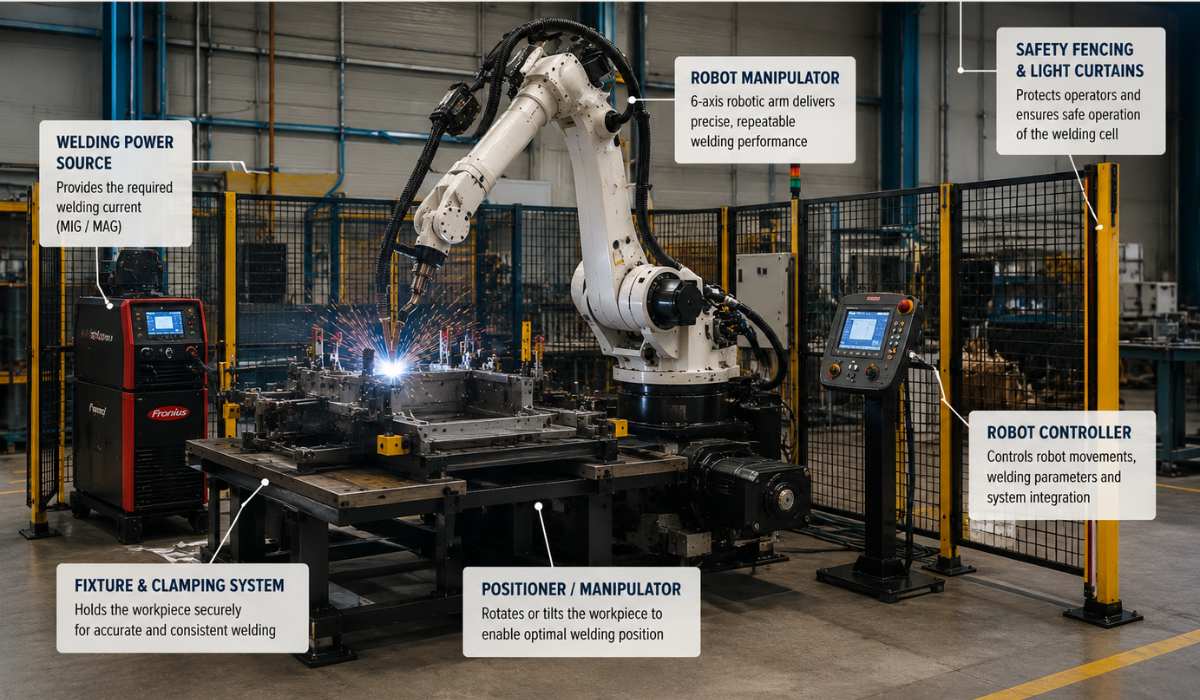
A functional robotic welding cell in 2026 costs between ₹25 lakh and ₹65 lakh delivered, commissioned, and producing acceptable parts.
Lower end: basic arc welding robot on a floor stand, manual part loading.
Upper end: dual-axis positioners, through-arc seam tracking, higher payload.
Key Takeaway
Fixture quality determines success more than robot brand. We have seen ₹4 lakh fixtures outperform ₹12 lakh fixtures because they were designed for the actual part family – and ₹15 lakh fixtures fail because the integrator ignored thermal distortion.
Component-Wise Robotic Welding System Cost India (2026)
| Component | Low-End (₹ Lakh) | Mid-Range (₹ Lakh) | High-End (₹ Lakh) | Notes |
|---|---|---|---|---|
| Robot arm (6-axis, 6–10 kg) | 9.0 | 12.5 | 18.0 | Arc welding spec |
| Welding power source (500A MIG) | 2.5 | 4.0 | 7.5 | Digital, synergic |
| Wire feeder & torch | 0.6 | 1.2 | 2.0 | Water-cooled for high duty |
| Robotic positioner | 2.5 | 5.0 | 9.0 | Servo-controlled |
| Welding fixtures | 3.0 | 6.0 | 12.0 | Do not cheap here |
| Safety fencing & light curtains | 1.2 | 1.8 | 2.5 | ISO 10218 |
| Controller & cables | Included | Included | Included | Part of robot package |
| Integration & PLC interfacing | 2.5 | 5.0 | 8.0 | Conveyor, loader interface |
| Robot programming & simulation | 1.5 | 2.5 | 4.0 | Offline + online |
| Commissioning & site acceptance | 1.0 | 1.5 | 2.5 | Travel, calibration |
| Training (operator + maintenance) | 0.5 | 0.8 | 1.2 | 3–5 days on-site |
| Annual Maintenance Contract (AMC) | 1.2 | 2.0 | 3.5 | Per year, after warranty |
| Spare parts inventory (initial) | 1.0 | 1.5 | 2.5 | Torch, liners, nozzles |
| Total (excl. GST) | ₹25.5 L | ₹43.8 L | ₹72.7 L |
What Determines Robotic Welding Price in India?
Five factors create the 2.5x spread between low and high-end systems.
1. Payload and reach – 6 kg robots cost less than 10–12 kg models needed for heavier torches or dual-wire setups.
2. Positioner type – Fixed table (cheap) vs. single-axis servo (mid) vs. twin-axis synchronised (expensive). Positioner cost often equals robot arm cost.
3. Fixture complexity – Manual clamping vs. pneumatic vs. servo-controlled clamps. Each level adds ₹2–5 lakh and reduces changeover time.
4. Integration depth – Basic I/O interfacing vs. full line integration with upstream conveyor, barcode reader, weld data logging for OEM traceability.
5. Brand and service footprint – Major brands (Fanuc, Yaskawa) carry a 10–15% premium over second-tier. That premium buys 24-hour spare availability in most industrial clusters – critical for uptime.
Manual vs Robotic Welding – Operational Reality
Table 2: Daily Differences That Drive ROI
| Parameter | Manual (Skilled Welder) | Robotic Welding Cell |
|---|---|---|
| Arc-on time per shift | 35–45% | 75–85% |
| Weld consistency (travel speed) | ±15% variation | ±2% variation |
| Rejection rate (typical) | 5–12% | 1–3% |
| Rework cost per part | High (grinding, re-weld) | Low (parameter adjust) |
| Shift-to-shift variation | Significant | None |
| Operator skill required | 6–24 months experience | 2–4 weeks training |
| Attendance dependency | Critical | Low (one per 2–3 cells) |
The rejection rate difference alone covers a significant portion of the robotic welding system cost in India within 18–24 months for medium-volume production (1,500+ parts/month).
Robotic Welding ROI in India — Where the Investment Pays Back
No generic “automation pays for itself.” Here is the framework used by Tier-1 automotive suppliers.
Five ROI Drivers
1. Labour reduction – One cell replaces 2–3 manual welders per shift. Two-shift operation: 4–6 welders. At ₹40,000/month fully loaded, annual saving: ₹19–29 lakh.
2. Rejection reduction – From 8% manual to 2% robotic on 5,000 components/month. Material + rework labour saving: ₹3–6 lakh/year.
3. Cycle time improvement – Robotic welding runs 20–40% faster than consistent manual welding. Robots don’t slow down at end of shift.
Many manufacturers first compare manual welding with fully automated robotic welding systems before calculating long-term ROI and production scalability.
4. Rework cost elimination – Rework consumes floor space, grinding consumables, and supervisor attention. Often 20–30% of rejection cost – undercounted in manual ROI.
5. OEM compliance – Major Indian OEMs now mandate weld data logging for Tier-1 suppliers. Without robotic welding, you cannot bid for certain contracts. The cost of not automating is lost revenue.
Realistic Case Study – Pune Automotive Supplier (2026)
Background: 120 employees, Tier-2. Produces 2,500 chassis brackets/month for commercial vehicle OEM. Manual CO₂ welding. 8% rejection. Night shift welder attendance 70%.
Pre-automation monthly costs:
-
Welder wages (6 welders, two shifts): ₹2.40 lakh
-
Rework labour (2 dedicated fitters): ₹0.70 lakh
-
Rejected material: ₹1.10 lakh
-
Rework consumables: ₹0.25 lakh
-
Total: ₹4.45 lakh/month
Robotic welding investment:
-
Cell with single-axis positioner + fixtures: ₹38 lakh
-
Installation & training: ₹1.8 lakh
-
Total: ₹39.8 lakh
Post-automation monthly costs:
-
Operator (1 per shift): ₹0.90 lakh
-
Maintenance & AMC (monthly avg): ₹0.20 lakh
-
Rejection rate: 2.2%
-
Rejected material + minor rework: ₹0.40 lakh
-
Total: ₹1.50 lakh/month
Monthly saving: ₹2.95 lakh | Annual saving: ₹35.4 lakh | Simple payback: 13.5 months
Key Takeaway
Realistic payback for most Indian manufacturers: 14 to 26 months, depending on utilisation, part mix, and fixture quality. Single-shift operations take longer (24–36 months).
When Robotic Welding Does NOT Make Sense
We decline more automation proposals than we accept. Here is why.
Low Production Volume
Below 8,000–10,000 weld metres per month, manual welding with good jigs is often cheaper. Rule of thumb: less than 600 parts/month with 20+ welds each – stay manual.
High Product Variation Without Family Logic
If you weld 200 different part numbers monthly with no geometric family, fixture changeover cost kills ROI. Each unique fixture costs ₹3–8 lakh. Robotic welding needs product families, not random job shop mixes.
Poor Fixture Design Capability
We have seen ₹45 lakh robotic cells produce 12% rejection because the client refused to invest in proper fixturing. The robot repeats perfectly. The fixture moves. The weld fails. If your team cannot design or maintain precision fixtures, automation will fail.
Weak Maintenance Culture
Robotic cells require preventative maintenance: torch cleaning, wire liner replacement, calibration verification. Plants without documented maintenance procedures should fix that before automating.
Unstable Production Demand
Volume fluctuating between 300 and 800 parts/month unpredictably makes amortisation impossible. Automation needs predictable, sustained schedules.
No In-House Programming Capability
Relying entirely on the integrator for every program change is expensive. You need at least one person trained in basic robot programming and path touch-up.
Key Takeaway
Honest automation assessment means saying “no” to the wrong applications. This protects your capital and our reputation.
Hidden Costs Most Buyers Ignore
Even experienced purchasers miss these six cost lines.
| Hidden Cost | Typical Range (₹ Lakh) | Why It’s Missed |
|---|---|---|
| Power quality stabiliser (for servo drives) | 0.8–1.5 | Industrial power fluctuates; robots hate it |
| Fume extraction integration | 1.5–3.0 | Often assumed as “plant existing” – rarely adequate |
| Floor reinforcement (vibration damping) | 0.5–1.2 | Positioners need rigid bases |
| Downtime during installation | 2–5 lakh (lost production) | Rarely capitalised upfront |
| Fixture changeover inventory (spare fixture sets) | 3–6 per set | Only realised after first changeover takes 4 hours |
| Operator turnover training (annual refresher) | 0.3–0.5 | Attrition doesn’t stop at automation |
Budget an additional 8–12% of cell price for these hidden costs. Otherwise, the robotic welding system cost in India ends up 20% higher than quoted.
Total Cost of Ownership – The Real Three-Year Picture
Purchase price is 60–70% of three-year TCO. The rest is maintenance, consumables, downtime, and training.
Table 3: Three-Year TCO (Mid-Range Cell, ₹44 Lakh Purchase)
| Cost Category | Year 1 | Year 2 | Year 3 |
|---|---|---|---|
| AMC (full coverage) | ₹2.0 L | ₹2.2 L | ₹2.4 L |
| Consumables (torch parts, liners) | ₹1.2 L | ₹1.5 L | ₹1.8 L |
| Spare drives & motors | ₹0.5 L | ₹1.0 L | ₹1.5 L |
| Fixture maintenance/replacement | ₹1.0 L | ₹1.5 L | ₹2.0 L |
| Operator training refresher | ₹0.3 L | ₹0.3 L | ₹0.5 L |
| Unplanned downtime (@ ₹5,000/hr) | ₹0.8 L | ₹0.6 L | ₹0.4 L |
| Software & programming support | ₹0.5 L | ₹0.5 L | ₹0.5 L |
| Annual TCO | ₹6.3 L | ₹7.6 L | ₹9.1 L |
| Cumulative (purchase + running) | ₹50.3 L | ₹57.9 L | ₹67.0 L |
Critical insight: The single largest hidden TCO item is poor integration – incorrect safety interlocks, unreliable weld start signals, or inconsistent part detection. That adds ₹8–12 lakh in lost production over 24 months.
Quality integration costs 15–20% of robot price. Cheap integration costs 40% in downtime and rework. Choose integrator based on reference calls, not price.
Why Robotic Welding Projects Fail – Integration, Fixtures & Downtime Reality
Fixture Quality > Robot Accuracy
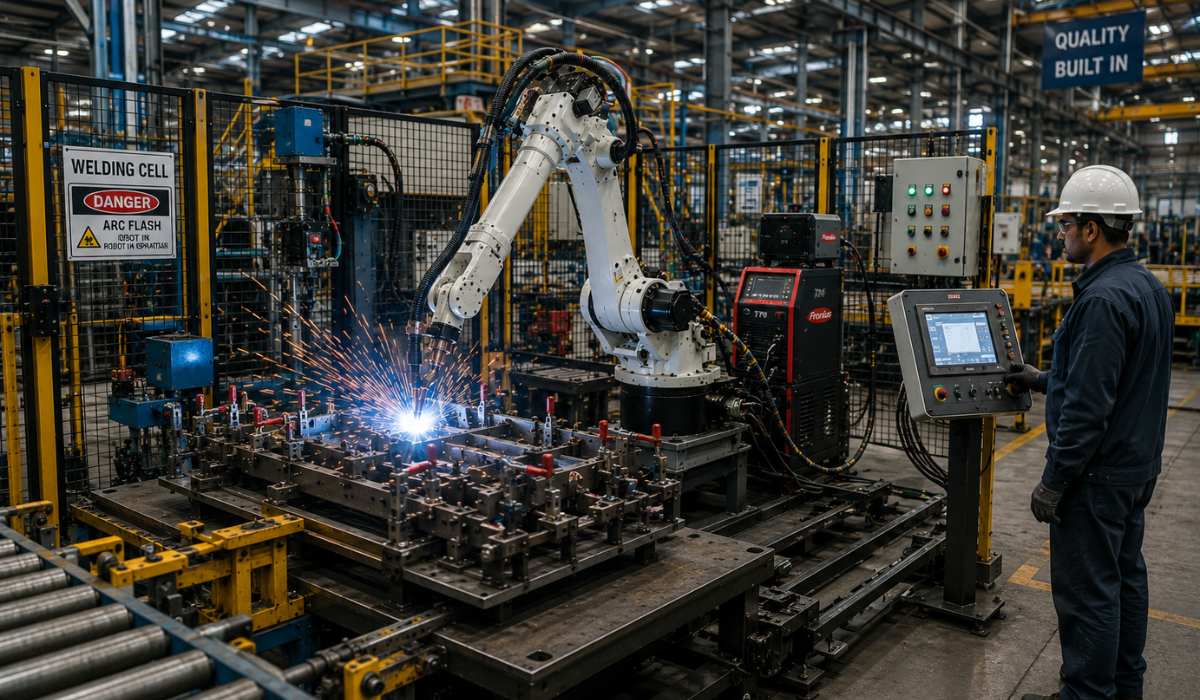
A welding robot has positional repeatability of ±0.05 mm. A manual fixture has ±0.5 mm on a good day. Thermal expansion during welding shifts parts 1–2 mm. If your fixture does not control this, weld placement fails.
We specify: hardened locating pins, pneumatic clamping, and copper backup bars for heat sinking on every production fixture. This adds ₹2–4 lakh per fixture. It reduces rejection by 60% compared to manual clamps.
Poor Integration Kills ROI
Integration is not just wiring. It is:
Sequence logic with upstream/downstream conveyors
Weld parameter management across part variants
Torch cleaning and tip-dressing automation
Vision or tactile part presence verification
Poor integration means your cell spends 15% of its time waiting for operator intervention. At ₹3 lakh per month of lost throughput, that adds up fast.
Cheap Automation Becomes Expensive Later
Second-tier robot brands may cost ₹3–5 lakh less upfront. But spare parts availability in India is inconsistent. Service response times are 3–5 days instead of 24 hours. When your cell is down for four days, the ₹3 lakh saving disappears – twice.
For low-duty applications (single shift, non-critical parts), second-tier can work. But know the support reality before buying.
Welding Consistency Matters for OEM Suppliers
Commercial vehicle OEMs now audit weld penetration and consistency via random cross-sectioning. Many suppliers struggle to maintain consistent audit performance with manual welding alone, especially on high-volume structural components. Robotic welding typically achieves 95–98% audit pass rates. Failing an OEM audit risks the contract.
Robot Brands & Service Reality in India (Based on Field Experience)
The following reflects common integration experience across Indian industrial clusters – not official benchmark data.
| Brand | Arc Welding Presence | Spare Availability | Service Coverage | Typical Price Premium |
|---|---|---|---|---|
| Fanuc | High | Excellent | Tier-1 cities + major belts | +10–15% |
| Yaskawa (Motoman) | High | Very good | Strong in West & South | +5–10% |
| ABB | Medium-High | Good | Major metro centres | +10–15% |
| KUKA | Medium | Fair | Limited to auto hubs | +8–12% |
| Kawasaki | Medium | Fair | Pune, Chennai, NCR | Base |
| Panasonic | Growing | Good | Tie-up dependent | Base to +5% |
Recommendation for most Indian manufacturers: Yaskawa or Fanuc for arc welding. Parts available through 8–10 distributors nationally. Service engineers within 250 km of most industrial clusters.
Budget alternative: Kawasaki with a strong local integrator – lower upfront cost, but verify spare supply before committing.
Implementation Roadmap – 90 Days to First Weld
| Week | Activity | Client Responsibility |
|---|---|---|
| 1–2 | Part selection, fixture design review | Provide 25+ samples, CAD if available |
| 3–6 | Fixture fabrication, offline programming | Prepare power, air, extraction |
| 7–8 | System assembly at integrator site | Send samples for test welding |
| 9 | FAT at integrator (1–2 days) | Bring quality team |
| 10 | Dismantle, ship, reinstall | Prepare floor, safety perimeter |
| 11–12 | Commissioning, programming adjustments | Assign dedicated operator for training |
| 13 | SAT, trial production, handover | Sign acceptance criteria |
Do not skip the Factory Acceptance Test (FAT). Fixing programming errors at your plant costs twice as much.
Frequently Asked Questions
1. What is the realistic robotic welding system cost in India for a basic arc welding cell?
₹25–32 lakh for a complete cell with 6–8 kg robot, 500A power source, manual loading, safety fencing, and single fixture. Excludes GST (18%) and civil work.
2. What is the typical return on investment period for robotic welding in India?
14–26 months for two-shift operations with stable production. Single-shift: 24–36 months. High-rejection applications (>10% manual) pay back faster.
3. How much maintenance does a robotic welding cell require?
Weekly: torch cleaning, nozzle change, liner inspection (15 min). Monthly: calibration, lubrication (2 hours). Quarterly: full PM by technician (4–6 hours). AMC strongly recommended after warranty.
4. Which industries in India are adopting robotic welding most rapidly?
Automotive Tier-1/2 (chassis, exhaust, seat frames), two-wheeler frames, agricultural equipment, construction attachments, and general fabrication with repeatable part families.
5. Can I retrofit my existing manual positioners with a robot?
Often yes, but with limits. Manual positioners lack servo control and repeatable stopping. For straight welds, retrofitting works. For contour welding, you need servo positioners – expect ₹3–7 lakh upgrade.
6. What is the minimum production volume to justify a robotic welding system?
Rule of thumb: 600–800 parts/month with 20+ inches of weld per part, or 12,000+ weld inches/month. Lower volumes can work if rejection >12% or labour is extremely scarce.
7. How long does robotic welding training take for existing staff?
Basic operation & program selection: 3 days. Troubleshooting & touch-up: 5 more days. Full program creation: 2–3 weeks supervised. Plan one trained technician per 2–3 cells.
8. Can the same robotic welding cell handle different part sizes?
Yes, within limits. Parts with similar weld joint geometries and fixturing families can run on the same cell. Changeover: 5 min (quick-change fixtures) to 45 min (bolted). Budget ₹3–6 lakh per additional fixture set.
Engineering-Focused Next Step
Robotic welding is a tool – not magic. It solves labour dependency, consistency, and rejection rate problems when applied to the right production environment.
If your operation meets the volume and part family criteria above, your next step is not a purchase order. It is a feasibility study covering:
Cycle time analysis for your specific parts
Fixture concept and cost estimate
Cell layout and floor space requirement
Detailed ROI with your actual rejection & labour data
Integration timeline and downtime plan
We provide this assessment as a paid engineering study. The fee is adjusted against integration if you proceed. No sales pitch. No hidden agenda.
Contact the engineering team:
Include your monthly volume, current rejection %, and number of welders. We respond with a preliminary assessment within 5 working days.
These are not theoretical numbers. They are line-items from actual 2026 purchase orders, service contracts, and rejection reports across Indian automotive and fabrication plants. If your production volume exceeds 600 parts per month, your rejection rate stays above 6%, and you run two shifts — the robotic welding system cost in India outlined above will generate a measurable return between 14 and 26 months. If those conditions are not met, do not automate. Wait until they are.
Recommended Reading:
Robotic Palletizing Solutions
Industry 4.0 Automation Solutions for Smart Manufacturing
Robotic Welding Fixtures
Industrial Robotics Automation for Indian Factories