
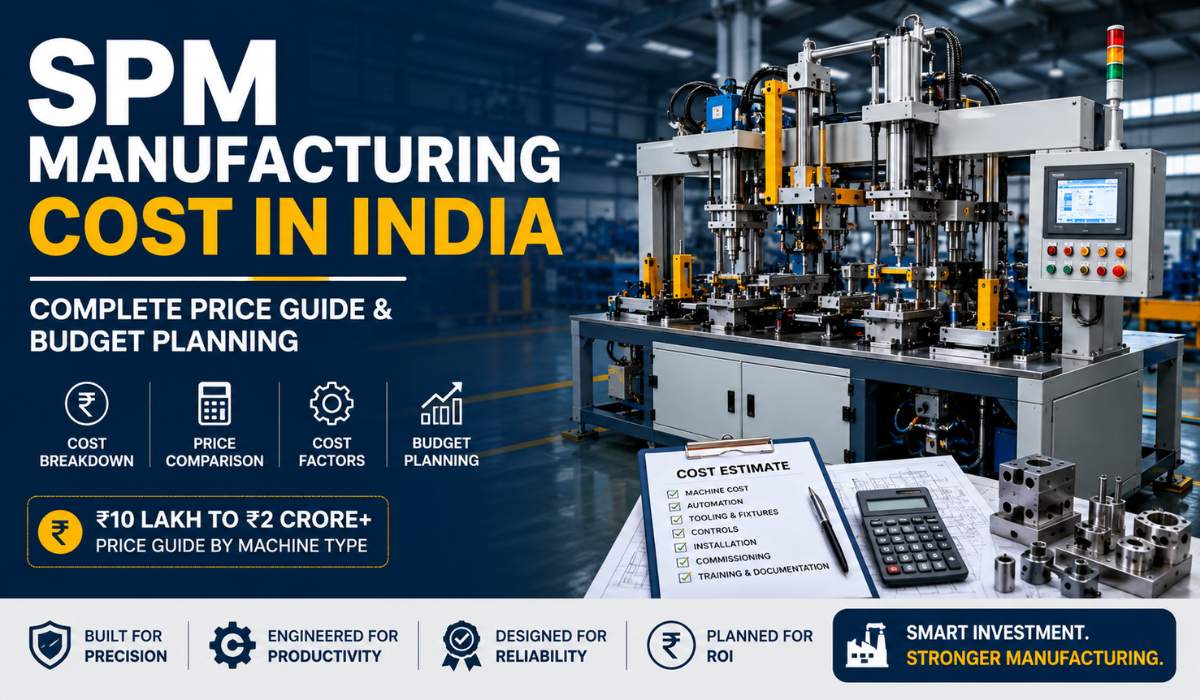
Every SPM project starts with the same question — what will it cost? The honest answer is that it depends on more factors than most quotes reveal. This guide breaks down exactly what drives SPM pricing in India, what a realistic budget looks like by machine type, and the costs that get left out of most initial quotes.
Table of Contents
- Why SPM Pricing Varies So Much Between Vendors
- How Much Does a Custom SPM Machine Cost in India?
- What Determines SPM Cost?
- SPM Cost Ranges by Machine Type
- Industries Using SPM Machines
- What’s Usually Missing From the Initial Quote
- Budget Planning Framework
- Comparing Vendor Quotes
- SPM vs Robotic Automation
- How to Reduce SPM Project Cost
- FAQs
Note for WordPress: link each TOC item to its corresponding heading anchor (e.g. #how-much-does-a-custom-spm-machine-cost-in-india). Most SEO plugins or a simple anchor-link block can do this automatically.
Why SPM Pricing Varies So Much Between Vendors
If you’ve requested quotes from three different SPM manufacturers for what feels like the same machine, you’ve probably received three very different numbers — sometimes a difference of 40 to 60 percent. This isn’t vendors padding their margins randomly. It reflects genuine differences in design depth, build quality, automation level, and what is actually included in the quoted price.
A low quote often excludes items that become mandatory during commissioning — safety interlocks to meet factory compliance, proper documentation, operator training, or a maintenance support plan. A higher quote from an experienced integrator may include all of this from day one. Comparing quotes without understanding what’s inside them is the single biggest reason SPM projects go over budget in India.
This guide gives you the actual cost ranges, the factors that move price up or down, and a framework to evaluate any quote you receive.
How Much Does a Custom SPM Machine Cost in India?
The cost of a custom Special Purpose Machine (SPM) in India typically ranges from ₹10 lakh for simple standalone machines to over ₹2 crore for fully automated multi-station systems. The final cost depends on process complexity, automation level, cycle time requirements, tooling design, quality inspection integration, and production volume.
For most automotive, engineering, and industrial manufacturing applications, SPM project budgets fall between ₹20 lakh and ₹90 lakh depending on the scope of automation and machine capability.
What Determines SPM Cost — The Core Factors
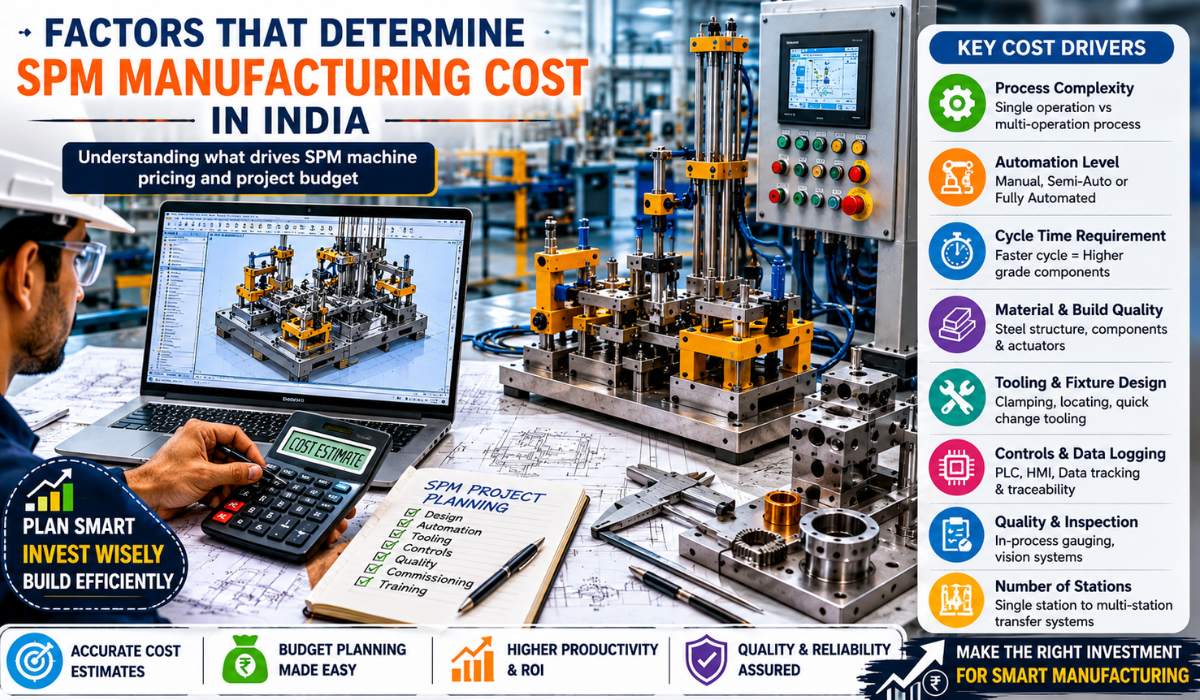
Before looking at price ranges in detail, understand what actually drives the number. To better understand the role of SPM in modern manufacturing, it’s important to look at the factors that directly influence machine cost and project scope. The same general type of machine can vary 3x in price based on these factors:
- Process complexity — a single-operation SPM (drilling only) costs far less than a multi-operation machine combining drilling, pressing, and inspection in one cycle
- Automation level — manual load/unload with semi-automatic cycle vs fully automatic with robotic loading changes cost significantly
- Cycle time requirement — tighter cycle times require higher-grade actuators, faster sensors, and more sophisticated control systems
- Material and build quality — mild steel frame vs precision-ground components, standard pneumatics vs servo-driven axes
- Tooling and fixture complexity — multi-axis clamping, quick-change tooling for variant handling, and precision locating all add cost
- Controls and data logging — basic PLC control vs full traceability with data export for OEM audit compliance
- Quantity of stations — single-station SPM vs multi-station transfer system with synchronized indexing
- Quality and inspection integration — does the SPM include in-cycle gauging and reject sorting, or is inspection separate
SPM Cost Ranges in India by Machine Type
| SPM Type | Typical Cost Range (INR) | What Drives the Range |
|---|---|---|
| Single-station drilling/boring SPM | ₹12 Lakh – ₹35 Lakh | Number of spindles, precision tolerance, cycle time |
| Welding SPM (single process) | ₹18 Lakh – ₹55 Lakh | MIG vs spot, fixture complexity, single vs multi-joint |
| Press and riveting SPM | ₹15 Lakh – ₹45 Lakh | Force capacity, force monitoring, multi-station design |
| Assembly SPM (multi-station) | ₹25 Lakh – ₹90 Lakh | Number of stations, pneumatic vs servo actuation, indexing type |
| Hydraulic fixture-based machining SPM | ₹20 Lakh – ₹70 Lakh | Clamping complexity, number of fixture stations, machining integration |
| Inspection/gauging SPM | ₹10 Lakh – ₹40 Lakh | Number of dimensions checked, vision integration, data logging |
| Fully automated multi-station transfer SPM | ₹60 Lakh – ₹2 Crore+ | Station count, robot integration, full traceability system |
These ranges reflect typical Indian market pricing for SPM projects, including design, fabrication, controls, and basic commissioning. Final cost depends heavily on the specific application — always get a detailed line-item quote rather than relying on these ranges alone.
Quick reference — typical cost by SPM type:
| SPM Type | Typical Cost |
|---|---|
| Drilling SPM | ₹12–35 Lakh |
| Welding SPM | ₹18–55 Lakh |
| Press SPM | ₹15–45 Lakh |
| Assembly SPM | ₹25–90 Lakh |
| Automated Transfer SPM | ₹60 Lakh – ₹2 Crore+ |
Which Industries Invest in SPM Machines?
Special Purpose Machines are widely used across industries where high-volume repetitive operations require improved productivity, consistency, and quality control. Many manufacturers adopt SPMs as part of a broader industrial automation strategy to improve productivity, reduce manual intervention and achieve consistent production quality.
Industries that commonly invest in SPM machines include:
- Automotive Manufacturing
- EV Component Manufacturing
- Aerospace Engineering
- Heavy Engineering
- Consumer Durable Manufacturing
- Industrial Equipment Manufacturing
- Precision Component Production
- Sheet Metal Fabrication
What’s Usually Missing From the Initial Quote
This is where SPM budgets most commonly go wrong. Clarify these items before comparing vendor quotes:
Foundation and installation — Civil work, anchor bolts, leveling, and utility connections (electrical, pneumatic) at your site. Often quoted separately or assumed to be the buyer’s responsibility.
Safety compliance items — Light curtains, interlocked guarding, emergency stop circuits — sometimes added as a mandatory afterthought once the factory safety officer reviews the machine.
Spare parts package — First-year wear parts — seals, sensors, pneumatic components. A vendor who doesn’t mention this upfront will bill it separately when something fails in month three.
Operator and maintenance training — Without structured training, your team becomes dependent on the vendor for every minor adjustment — a cost that compounds over the machine’s life.
Annual Maintenance Contract (AMC) — Ongoing calibration, preventive maintenance, and guaranteed response times. Not included in capital cost but essential for sustained uptime.
Documentation package — Drawings, electrical schematics, PLC program backup, and maintenance manuals specific to your machine — not just generic component manuals.
Budget Planning Framework — How to Plan Before You Quote
Before approaching any SPM manufacturer, work through these steps internally. This prevents both under-budgeting and over-specifying.
- Define your actual cycle time requirement — derive this from your line takt time, not from a wish list. Over-specifying cycle time inflates cost significantly with no operational benefit if your line doesn’t need it.
- Confirm production volume for the next 24-36 months — SPM capital is only justified by sustained volume. If your volume projection is uncertain, consider a phased automation approach instead of a single large SPM.
- Freeze the part drawing — an SPM is designed around a specific part revision. Quoting against an unfinalized drawing leads to expensive engineering changes mid-project.
- List your non-negotiable quality requirements — dimensional tolerances, surface finish, in-process inspection needs. These directly determine machine cost and should be defined before, not during, quoting.
- Add a 15-20% contingency to any quote — for site-specific installation costs, minor design changes during commissioning, and the first-year spares package.
- Decide on AMC from day one — build the ongoing maintenance cost into your total cost of ownership calculation, not as a surprise expense after warranty ends.
How to Compare Quotes From Different Vendors
When you receive multiple quotes for the same application, don’t compare the headline number alone. Use this checklist to normalize the comparison:
| Compare This | Why It Matters |
|---|---|
| Cycle time guarantee | Is it validated under production conditions, or just stated as a target? |
| Scope of supply | Does it include safety guarding, controls, and commissioning, or are these separate line items? |
| Fixture design ownership | Is fixture design in-house or subcontracted? This affects accountability for accuracy issues. |
| Spare parts inclusion | Is a first-year spares kit included, or will you need to order parts reactively? |
| Training and documentation | What specifically is included — hours of training, manual format, program documentation? |
| Payment terms | What percentage is tied to commissioning sign-off vs upfront payment? |
| Warranty period and AMC option | What is covered, for how long, and is an AMC offered with specific response times? |
A quote that looks 20% cheaper but excludes fixture ownership, spares, and training is not actually cheaper — it shifts those costs to you later, usually at a worse price and a worse time.
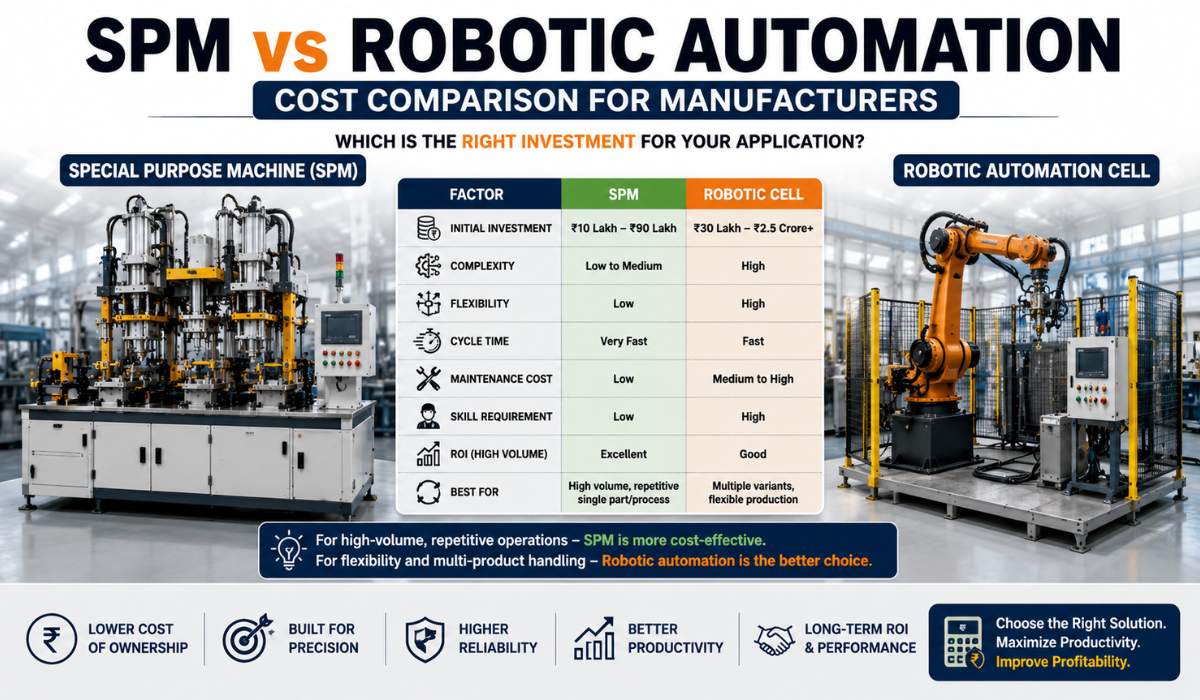
SPM vs Robotic Automation — A Quick Cost Reality Check
Many manufacturers evaluating automation compare SPM cost against robotic automation systems without recognizing they solve different problems. SPMs are generally lower cost for a single, well-defined, repetitive operation. Robotic systems offer more flexibility across part variants but typically cost more for an equivalent single-operation task.
If your requirement is a single fixed process at high volume — an SPM usually delivers better cost-per-unit. If you need flexibility across multiple part variants or complex multi-axis movement — a robotic system, even at higher capital cost, often delivers better total value. The decision should follow your production requirement, not the other way around.
How to Reduce SPM Project Cost Without Compromising Quality
Many manufacturers assume that reducing machine cost means sacrificing quality. In reality, the biggest savings often come from better scope definition rather than cutting engineering standards.
Ways to optimize SPM project cost include:
- Finalizing part drawings before design begins
- Avoiding unnecessary cycle time specifications
- Using standard automation components where possible
- Planning preventive maintenance from day one
- Choosing scalable automation architecture
- Standardizing fixtures across product variants
How PARC Robotics Prices SPM Projects
At PARC Robotics, every SPM quote begins with a detailed requirement review — your part drawing, volume, cycle time, and quality requirements — before we provide a price. We do not provide ballpark quotes without this review, because ballpark numbers without scope definition are the primary cause of budget overruns later in the project.
Our quotes include fixture and tooling design (done in-house, not subcontracted), controls and PLC programming, on-site commissioning, first article validation, and a documentation package specific to your machine. We discuss spares packages and AMC options at the quoting stage, not after installation.
We have designed and built SPMs across welding, drilling, pressing, assembly, and inspection applications for automotive and industrial manufacturers across India since 2016.
Frequently Asked Questions
What is the cost of a Special Purpose Machine in India?
The cost of a Special Purpose Machine (SPM) in India typically ranges from ₹10 lakh to over ₹2 crore depending on machine complexity, automation level, production volume and quality requirements.
What is the average cost of an SPM machine in India?
The average cost of an SPM machine in India ranges from ₹15 lakh to ₹90 lakh depending on machine complexity, automation level, cycle time requirements and production volume.
Why do SPM machine prices vary so much?
SPM prices vary due to differences in machine design, automation level, tooling complexity, cycle time requirements, quality inspection systems and included services such as commissioning and training.
Is an SPM cheaper than robotic automation?
For high-volume repetitive operations, an SPM is often more cost-effective than a robotic cell. However, robotic automation provides greater flexibility for handling multiple product variants.
How long does it take to manufacture an SPM machine?
Most SPM projects require 8 to 24 weeks depending on design complexity, tooling requirements, automation level and testing requirements.
What factors increase SPM project cost?
Advanced automation, servo systems, robotic integration, shorter cycle times, in-process inspection and multi-station configurations can significantly increase SPM project cost.
Should AMC be included in SPM budgeting?
Yes. Annual Maintenance Contracts help reduce downtime, improve machine reliability and provide predictable maintenance costs throughout the machine lifecycle.
Related Guides:
Automated Weld Quality Inspection
Why Your Automotive Automation Experience Won’t Work for EV Batteries
Robotic Welding System Cost in India
Need an Accurate SPM Project Budget?
Share your part drawing, production volume, cycle time target and quality requirements with our engineering team. PARC Robotics will provide a detailed technical assessment and customized cost estimate based on your specific manufacturing application.
Typical response time — Within 24 working hours.
Concept-level budget estimates — Available before final machine design — so you can plan capex approval before committing to detailed engineering.
Contact PARC Robotics: sales@parcrobotics.in