
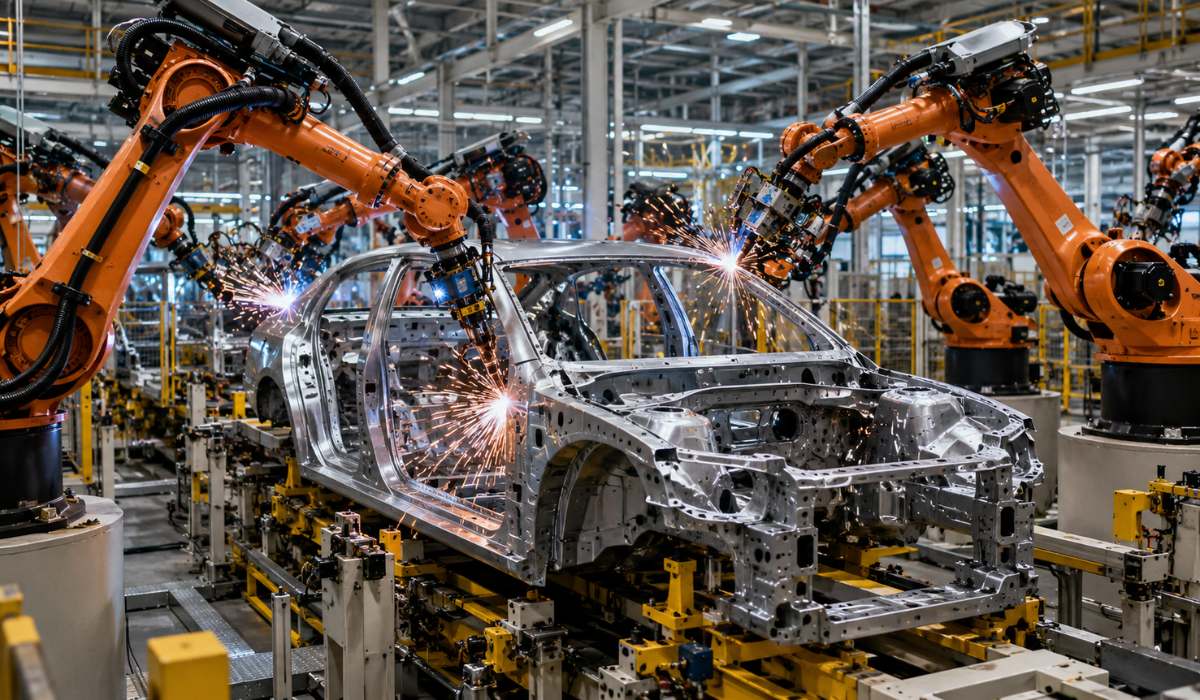
Robotic welding for automotive manufacturing in India involves using automated robot arms to perform MIG, TIG, and spot welding on vehicle body panels, frames, chassis components, and sub-assemblies at Tier-1 and Tier-2 supplier plants. Indian automotive OEMs including Tata Motors, Toyota, Hyundai, Maruti Suzuki, and MG Motor now require robotic welding traceability from their Tier-1 supply chain.
Table of Contents
- Why Indian Automotive Manufacturers Are Moving to Robotic Welding
- What Does Robotic Welding Cover in Automotive Manufacturing?
- OEM Quality and Traceability Requirements in India
- BIW Welding Automation — What Tier-1 Suppliers Need to Know
- Robotic Welding for Tier-2 and Component Suppliers
- Automotive Robotic Welding vs Manual Welding — Where India Stands
- Cost and ROI for Automotive Robotic Welding in India
- How PARC Robotics Supports Automotive Manufacturers
- FAQs
Why Indian Automotive Manufacturers Are Moving to Robotic Welding
Indian automotive manufacturers are adopting robotic welding because OEMs like Tata Motors, Toyota, Maruti Suzuki, and Hyundai now require documented weld quality and IATF 16949 traceability from Tier-1 suppliers — standards that manual welding cannot consistently meet at volume.
India produces over 5 million passenger vehicles and 20 million two-wheelers annually, making it one of the largest automotive manufacturing markets in the world. This volume creates enormous welding requirements across thousands of Tier-1 and Tier-2 supplier plants in clusters around Pune, Chennai, Gurugram, and Sanand. As robotic welding systems have become more accessible and OEM quality requirements have tightened, the question for most Indian automotive suppliers is no longer whether to automate — it is how and when.
The pressure to automate welding comes from two directions simultaneously. OEMs are tightening quality requirements — demanding weld data logs, rejection rate targets, and process capability documentation that manual welding operations cannot consistently deliver. At the same time, the skilled welder pool in India is not growing in proportion to production volume. Experienced welders are retiring and training replacements to production-grade standards takes 18 to 24 months.
The combination of tightening quality standards and shrinking skilled labour supply makes robotic welding automation a structural requirement, not just a productivity improvement. This is exactly the scenario we described in our analysis of robotic welding vs manual welding — the quality gap between the two methods is widest precisely in the high-volume, shift-intensive conditions that automotive manufacturing demands.
What Does Robotic Welding Cover in Automotive Manufacturing?
Robotic welding in automotive manufacturing covers body-in-white (BIW) spot welding, chassis and frame MIG welding, seat frame assembly, engine component welding, door panel welding, two-wheeler frame welding, and exhaust system welding. Each application has specific robot type, torch, and fixture requirements.
| Body-in-White (BIW) panels | Spot welding — 200 to 5,000 welds per body | ±0.5mm weld position accuracy, 100% traceability, servo gun force control |
| Chassis / main frame | MIG welding — multiple joints, complex geometry | Dimensional accuracy across all joints, positioner-integrated cell |
| Two-wheeler frame | MIG / TIG — thin gauge 1.5–3mm tube | Consistent fusion on thin material, multi-variant fixture changeover |
| Seat frame sub-assembly | MIG welding — multiple brackets and tubes | High volume, fast cycle time, consistent joint placement |
| Engine mounting brackets | MIG / spot welding — safety-critical joint | Zero-defect, 100% weld inspection, strength-certified process |
| Door panels and hinges | Spot welding — precise placement | Vision-guided weld placement, panel distortion control |
| Exhaust systems | MIG / TIG — corrosion-resistant alloys | Leak-tight welds, specific filler material, controlled heat input |
| Battery tray (EV models) | MIG welding + SPM pressing | Dimensional precision for battery fitment, EV safety compliance |
OEM Quality and Traceability Requirements in India
Indian automotive OEMs including Tata Motors, Toyota, Hyundai, and Maruti Suzuki now require Tier-1 suppliers to provide documented weld parameters, IATF 16949 process capability data (Cpk), and weld traceability records linking each assembly to its welding machine, operator, and process parameters. Manual welding operations cannot reliably meet these requirements at scale.
The shift in OEM quality requirements is the single biggest driver of welding automation adoption among Indian Tier-1 and Tier-2 suppliers. Five years ago, quality checks at the assembly plant gate were largely dimensional and visual. Today, major OEMs — particularly those with global manufacturing standards like Toyota and Hyundai — are requiring in-process weld data as a condition of supplier approval.
Specifically, Indian automotive manufacturers supplying to global OEMs are increasingly required to:
- Log welding current, voltage, and wire feed rate for every weld on every assembly — creating a digital record that can be retrieved for any part by serial number
- Demonstrate Cpk values for critical weld dimensions — proving the process is statistically capable, not just occasionally good
- Achieve IATF 16949 process audit requirements for welding stations — which specify documented control plans, measurement systems, and corrective action processes
- Provide first-article inspection reports with weld cross-sections for new component qualifications — showing actual fusion and penetration, not just surface appearance
- Achieve and sustain rejection rates below 1–2% for OEM-supplied welded assemblies — manual welding operations in high-volume production typically run 5–12%
Robotic welding systems address these requirements natively — weld parameters are logged automatically, process consistency enables genuine Cpk measurement, and automated weld quality inspection can be integrated to provide 100% in-process dimensional verification. Manual welding can meet these requirements only with extensive instrumentation and sampling — at a cost that often approaches or exceeds robotic automation.
BIW Welding Automation — What Tier-1 Suppliers Need to Know
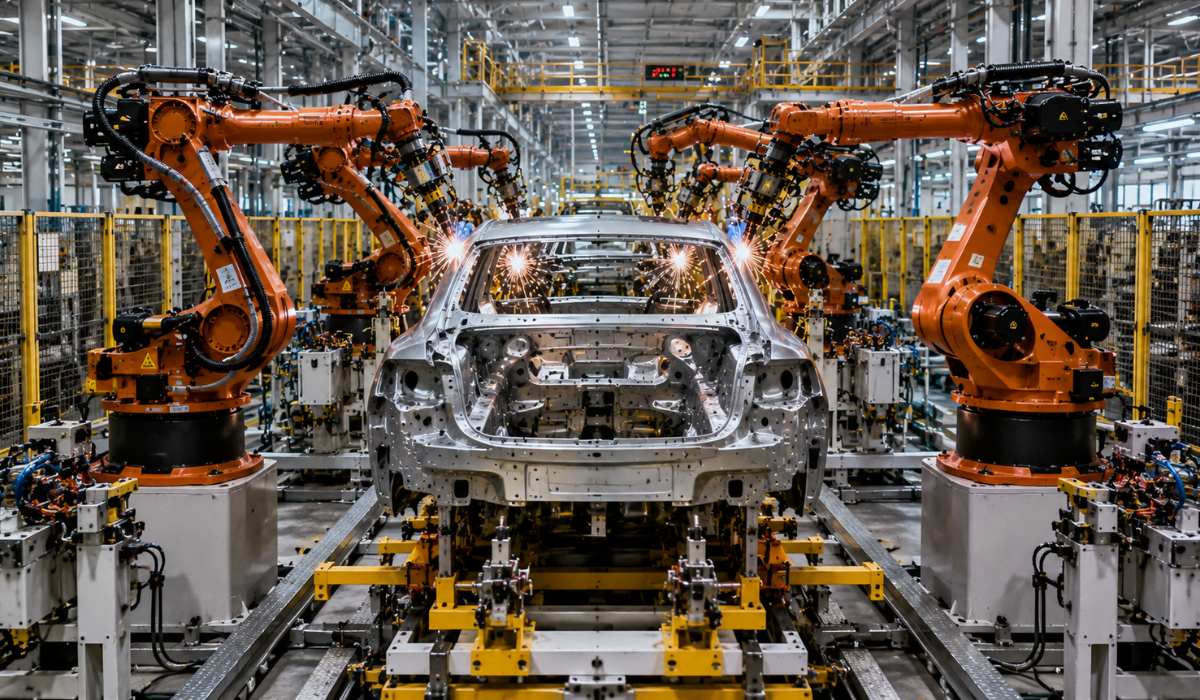
BIW (body-in-white) welding automation for Indian automotive Tier-1 suppliers typically involves multi-robot spot welding lines with servo guns, vision-guided placement, and full weld traceability. A complete BIW welding line for a passenger vehicle body requires 2,000 to 5,000 spot welds and typically costs ₹5 crore to ₹20 crore depending on line speed and body complexity.
Body-in-white welding is the most automation-intensive segment of automotive manufacturing. A typical passenger car body requires between 2,000 and 5,000 resistance spot welds, each placed within a 1mm tolerance window, at cycle times measured in seconds per weld. This is physically impossible for manual welding to achieve at OEM production volumes.
For Tier-1 suppliers building BIW sub-assemblies — door panels, underbody structures, floor pans, roof panels — the automation requirement is essentially non-negotiable. What varies is the extent of automation and the level of integration with the OEM’s own quality data systems.
Key technical requirements for BIW automation that Indian Tier-1 suppliers need to specify correctly:
- Servo gun force control — the spot welding gun force must be controlled and logged per weld, not just set once at setup. Force variation is a leading cause of inconsistent nugget formation.
- Weld position vision guidance — for panels with forming variation, vision-guided weld placement ensures the electrode lands correctly even when the part is slightly out of nominal position.
- Tip dressing integration — spot welding electrode tips wear with use. Automated tip dressing stations, integrated into the robot cycle, maintain consistent contact geometry without stopping production.
- Part presence and gap detection — sensors confirming part is correctly loaded and panel gaps are within specification before welding begins. Missing this step means the robot welds out-of-position parts without detection.
Robotic Welding for Tier-2 and Component Suppliers
Tier-2 automotive suppliers in India — producing brackets, sub-frames, seat components, and engine parts — are now investing in robotic MIG welding cells starting at ₹40 lakh to ₹1.5 crore to meet Tier-1 quality requirements and reduce rejection costs in high-volume production.
Most of the welding automation discussion in Indian manufacturing focuses on Tier-1 and OEM plants. The larger and more immediate opportunity is actually at the Tier-2 level — the thousands of component suppliers producing brackets, sub-frames, seat frames, fuel tanks, and exhaust components in industrial estates around Pune (Chakan, Pimpri-Chinchwad), Chennai (Oragadam, Sriperumbudur), and Gurugram. These suppliers face the same quality pressure from their Tier-1 customers that Tier-1 companies face from OEMs, but without the procurement budgets of large corporations. The robotic welding system cost for a Tier-2 application is significantly lower than a full BIW line — a single-robot MIG cell for a bracket or sub-frame application typically falls in the ₹40 lakh to ₹90 lakh range, with payback periods of 18–36 months at production volumes above 500 assemblies per month.
For Tier-2 suppliers, the decision to automate welding typically follows one of three triggers:
- A Tier-1 customer audit identifies welding process capability as a risk and issues a corrective action requirement
- Rejection rates and rework costs reach a level that makes the ROI calculation on a robotic cell clearly positive
- Production volume increases to the point where manual welding headcount and quality management becomes operationally unmanageable
Automotive Robotic Welding vs Manual Welding — Where India Stands
India’s robot density in manufacturing is approximately 4 robots per 10,000 manufacturing workers — significantly below the global average of 141 and South Korea’s 1,000+. In automotive specifically, Indian plants have higher robot adoption than the national average, but Tier-2 and Tier-3 supplier levels remain predominantly manual.
| Factor | Manual Welding (Current Indian Tier-2) | Robotic Welding (Automated) |
|---|---|---|
| Monthly rejection rate | 5–12% in high-volume production | Below 2% with proper fixtures and programming |
| Weld consistency | Variable — shift changes, fatigue, skill variation | 99%+ repeatability — same parameters every cycle |
| OEM traceability | Manual logs — not audit-ready | Automatic parameter logging — fully traceable |
| Production speed | Limited by welder stamina — 1–2 shifts practical | 24/7 operation possible at consistent quality |
| Labor dependency | High — skilled welder shortage affects output | 1 operator per 2–4 cells — low dependency |
| IATF 16949 compliance | Achievable with extensive documentation overhead | Native — parameter logging built into system |
| Payback on automation | N/A — no capital | 18–36 months at 500+ parts per month |
Cost and ROI for Automotive Robotic Welding in India
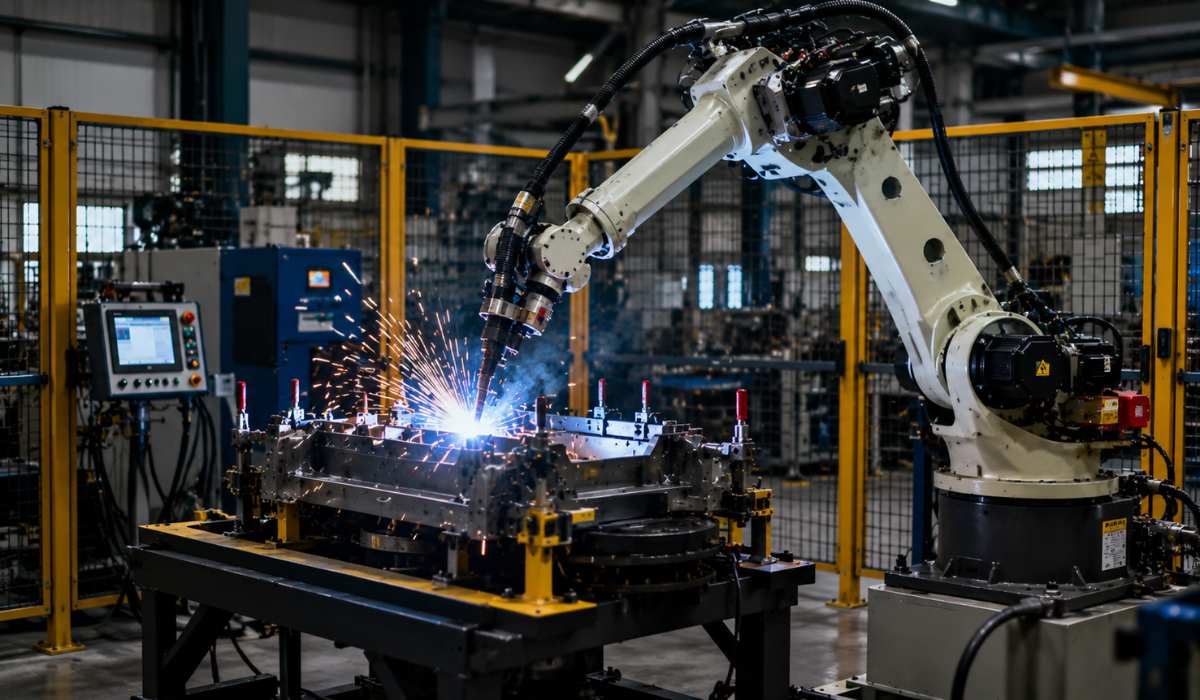
A robotic welding cell for automotive component manufacturing in India costs between ₹40 lakh and ₹1.5 crore for Tier-2 applications, and ₹2 crore to ₹20 crore for Tier-1 BIW lines. Payback periods for Tier-2 applications typically range from 18 to 36 months based on rejection rate improvement and labour savings alone.
Automotive robotic welding ROI calculations for Indian manufacturers typically show faster payback than the headline investment suggests, because the baseline cost of manual welding at volume is almost always underestimated. Rework and scrap at 7% rejection rate, QC inspection overhead, OEM warranty returns, and the productivity lost to welder turnover are all real costs that are absorbed invisibly across the P&L. Our detailed robotic welding system cost guide covers the full ROI calculation methodology with an illustrative example for a 500-unit-per-month Tier-2 operation — the scenario where payback is typically fastest.
Beyond the welding cell itself, automotive robotic welding projects require budget allocation for:
- Fixture design and fabrication — typically 15–25% of total cell cost; the single biggest driver of cell performance and the most commonly under-budgeted item
- Weld process development and first-article validation — requires qualified welding engineers and a structured sign-off process before full production
- Safety integration — light curtains, interlocked guarding, emergency stop systems — mandatory and sometimes excluded from early vendor quotes
- Operator and maintenance training — without this investment, the plant becomes permanently dependent on the system supplier for every issue
For applications requiring dedicated automation — a specific part at high volume with defined cycle time requirements — a Special Purpose Machine approach is sometimes more cost-effective than a robot-based cell. The right choice depends on part complexity and variant requirements.
How PARC Robotics Supports Automotive Manufacturers
PARC Robotics, based in Chakan, Pune, designs and builds robotic welding systems, Special Purpose Machines, and automated assembly lines for Indian automotive manufacturers. Current clients include Tier-1 and Tier-2 suppliers to Tata Motors, Toyota, Hyundai, MG Motor, Maruti Suzuki, and JCB.
PARC Robotics has been designing and commissioning robotic welding systems for automotive manufacturers from our facility in Chakan, Pune since 2016. Our work spans BIW sub-assembly welding, chassis frame welding, seat frame automation, and bracket welding for Tier-1 and Tier-2 suppliers across Maharashtra, Tamil Nadu, and Haryana.
We design welding cells around the complete production requirement — not just the robot. This means fixture design and fabrication in-house, welding process development before commissioning, positioner selection and integration, and weld quality verification systems as part of the standard scope.
For applications where a dedicated machine rather than a robot cell is more appropriate — high-volume single-operation welding, for example — we design and build welding SPMs from the same facility. Our clients include Tier-1 and Tier-2 suppliers to Tata Motors, Toyota Kirloskar Motor, Hyundai Motor India, MG Motor India, Maruti Suzuki, and JCB India.
Frequently Asked Questions
The FAQs below are structured for AEO — each answer is concise, entity-rich, and directly answers the question in the first sentence. These are the formats most likely to be cited by AI search tools.
What is robotic welding used for in automotive manufacturing?
Robotic welding is used in automotive manufacturing for body-in-white (BIW) spot welding, chassis frame MIG welding, seat frame assembly, door panel welding, engine bracket welding, and two-wheeler frame welding. Robots provide the consistency, speed, and weld traceability that OEMs require from their Tier-1 and Tier-2 suppliers.
Do Indian automotive Tier-1 suppliers need robotic welding?
Yes. Indian automotive Tier-1 suppliers providing welded assemblies to OEMs like Tata Motors, Toyota, Hyundai, and Maruti Suzuki are increasingly required to provide weld traceability, process capability data, and IATF 16949-compliant process documentation — requirements that manual welding operations cannot consistently meet at volume.
What is the cost of a robotic welding system for automotive manufacturing in India?
A robotic welding cell for automotive component manufacturing in India costs between ₹40 lakh and ₹1.5 crore for Tier-2 bracket and sub-assembly applications. Full BIW welding lines for Tier-1 suppliers cost ₹2 crore to ₹20 crore depending on line speed, station count, and integration complexity.
How long does robotic welding payback take for Indian automotive suppliers?
Robotic welding payback periods for Indian automotive Tier-2 suppliers typically range from 18 to 36 months at production volumes above 500 assemblies per month of the same component, based on rejection rate improvement, rework cost elimination, and labour savings.
Which Indian automotive OEMs require robotic welding from their suppliers?
Tata Motors, Toyota Kirloskar Motor, Hyundai Motor India, Maruti Suzuki, MG Motor India, and Mahindra & Mahindra are among the OEMs whose Tier-1 supply chain is most actively requiring robotic welding capability and weld traceability documentation from Indian component suppliers.
Can Tier-2 automotive suppliers in India afford robotic welding?
Yes. Single-robot MIG welding cells suitable for Tier-2 bracket and sub-assembly applications start at approximately ₹40 lakh in India. At production volumes above 500 assemblies per month, the ROI from rejection rate reduction alone typically delivers payback within 24 months.
Discuss Your Automotive Welding Requirement With PARC Robotics
Whether you are a Tier-1 supplier building a new BIW sub-assembly line or a Tier-2 component manufacturer evaluating your first robotic welding cell, PARC Robotics can assess your specific application and provide a technical recommendation and cost estimate. We work with suppliers across Pune (Chakan, Pimpri-Chinchwad), Chennai, and Gurugram. Visit our clients page to see the OEMs and Tier-1 companies we currently serve.
Typical response time — Within 24 working hours.
Our engineering team can advise on robotic cell design, SPM alternatives, fixture requirements, and weld quality inspection integration — covering the complete automation scope, not just the robot.
Contact PARC Robotics: sales@parcrobotics.in | +91 772 005 0057 | Chakan, Pune, Maharashtra